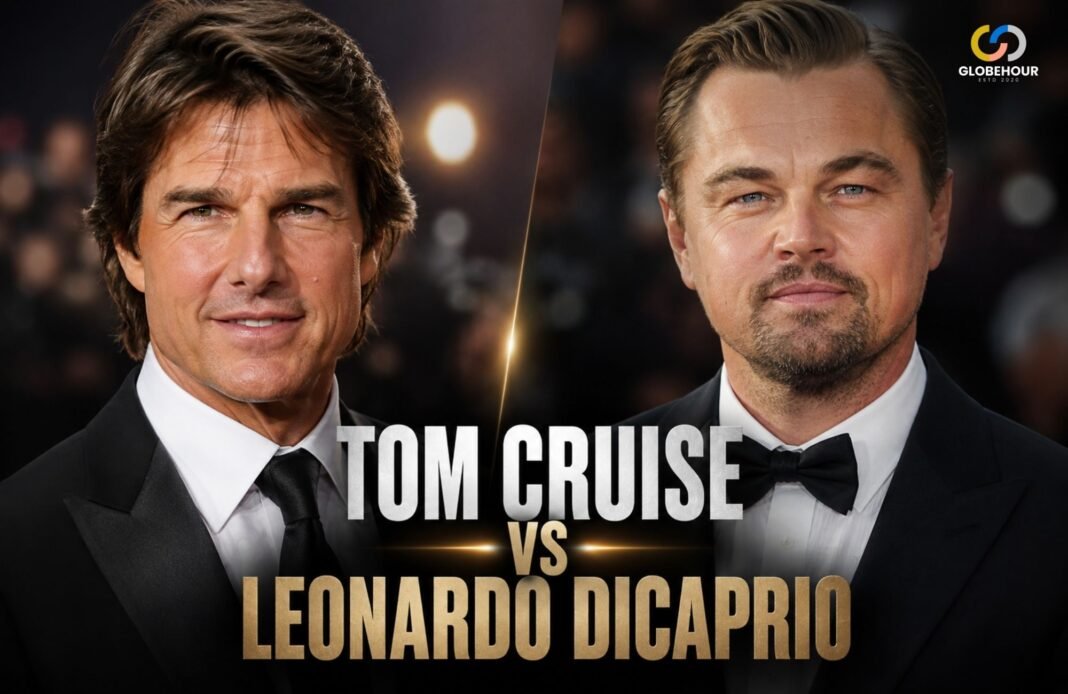
The Tom Cruise vs Leonardo DiCaprio comparison is one of the most interesting match-ups in Hollywood, mostly because it isn’t really a rivalry at all. They almost never compete for the same roles. Tom Cruise is the ultimate action-franchise movie star, built on spectacle, discipline, and global box office muscle. Leonardo DiCaprio is the prestige dramatic actor, built on intense roles, great directors, and award-season respect.
Both men became famous young. Both stayed in the spotlight for decades. Both worked with major filmmakers and reshaped Hollywood in their own ways. But they did it from opposite directions, and that is exactly what makes a Tom Cruise vs Leonardo DiCaprio breakdown worth doing properly.
Below, we line them up category by category, from their early lives to their 2020s projects, and finish with a clear verdict on who wins where.
Tom Cruise vs Leonardo DiCaprio: Basic Profile
Before the deep dive, here is the quick side-by-side. It already shows the core difference: one man built a signature franchise, the other built a filmography around directors.
| Category | Tom Cruise | Leonardo DiCaprio |
|---|---|---|
| Full name | Thomas Cruise Mapother IV | Leonardo Wilhelm DiCaprio |
| Born | July 3, 1962 | November 11, 1974 |
| Birthplace | Syracuse, New York | Los Angeles, California |
| Career start | 1981 | Late 1980s / early 1990s |
| Core image | Action superstar, stunt performer | Dramatic actor, Oscar winner |
| Signature franchise | Mission: Impossible | No traditional franchise |
| Biggest box office film | Top Gun: Maverick | Titanic |
| Oscar status | Honorary Award + nominations | Best Actor winner |
| Public cause | Theatrical cinema | Environmental activism |
For full filmographies, the easiest references are the Tom Cruise IMDb page and the Leonardo DiCaprio IMDb page.
Early Life: Two Very Different Starts
Tom Cruise had a difficult childhood. Born in Syracuse, New York, he moved often because of his family situation. His father was an electrical engineer, his mother a special education teacher. He attended many schools, spent part of his childhood in Canada, and even briefly considered the priesthood before drama gave him direction.
Leonardo DiCaprio grew up inside the system. Born and raised in Los Angeles, close to the entertainment industry, he started in commercials and television before moving into film.
Cruise fought his way into Hollywood from the outside. DiCaprio grew up inside it and learned how to survive it.
Career Breakthrough: Star First vs Actor First
Cruise got early attention with Taps and The Outsiders, but Risky Business (1983) made him a young star, and Top Gun (1986) turned him into a global symbol. By the end of the decade he had already shown range with Rain Man and Born on the Fourth of July, earning his first Oscar nomination.
DiCaprio’s breakout came through pure acting skill. This Boy’s Life got him noticed, and What’s Eating Gilbert Grape earned him an Oscar nomination at just 19. Global fame arrived later with Romeo + Juliet and, above all, Titanic.
Cruise became a movie star first, then proved he could act. DiCaprio proved he could act first, then became a movie star.
Tom Cruise vs Leonardo DiCaprio in the 1980s and 1990s
Cruise dominated both decades. The 1990s alone gave him A Few Good Men, The Firm, Interview with the Vampire, Jerry Maguire, Eyes Wide Shut, Magnolia, and the first Mission: Impossible, which he also produced.
DiCaprio’s 1990s were about transformation. After Titanic made him a global heartthrob overnight, he turned selective, determined not to be trapped as a romantic idol.
The takeaway: Cruise had the more consistent decade-long commercial run, while DiCaprio had the single biggest cultural explosion with Titanic.
2000s: Reinvention on Both Sides
Cruise leaned into sci-fi and large-scale thrillers like Minority Report, War of the Worlds, and The Last Samurai, a chilling villain in Collateral, and even comedy in Tropic Thunder. But his public image took serious damage over Scientology advocacy and his comments about psychiatry.
DiCaprio used the decade to rebuild as a serious adult actor, launching his landmark partnership with Martin Scorsese on Gangs of New York, The Aviator, and The Departed.
Cruise’s 2000s were commercially powerful but turbulent. DiCaprio’s were artistically strategic.
2010s: Action King vs Prestige Powerhouse
This is where the Tom Cruise vs Leonardo DiCaprio split becomes clearest. Cruise became the face of practical action cinema with Mission: Impossible – Ghost Protocol, Rogue Nation, Fallout, and Edge of Tomorrow.
DiCaprio ran arguably his strongest artistic decade: Shutter Island, Inception, Django Unchained, The Wolf of Wall Street, and finally his long-awaited Oscar for The Revenant.
The takeaway: Cruise owned the box office, while DiCaprio owned the awards stage.
Tom Cruise vs Leonardo DiCaprio in the 2020s
Cruise’s 2020s were defined by Top Gun: Maverick, the biggest film of his career, plus the final stretch of Mission: Impossible, ending with The Final Reckoning, which he has said is his last turn as Ethan Hunt.
DiCaprio stayed selective, appearing in Don’t Look Up, Killers of the Flower Moon, and One Battle After Another.
Acting Style: Kinetic vs Psychological
Cruise acts with energy, control, and intensity, and is most famous for physical acting like running, climbing, and flying, making action feel personal because he performs the stunts himself.
DiCaprio is the more psychological performer, specializing in men who are hiding something or quietly breaking down: obsession in The Aviator, paranoia in The Departed, greed in The Wolf of Wall Street.
Cruise’s body drives the performance. DiCaprio’s psychology drives it.
Box Office Power: Who Sells More Tickets?
In raw commercial terms, Tom Cruise has the stronger box office identity. His films have grossed more than $13.3 billion worldwide, and he holds a Guinness World Record for eleven consecutive $100-million films from 2012 to 2025.
DiCaprio’s leading roles have grossed around $7 billion worldwide, remarkable precisely because he avoids franchises. For up-to-date figures, Box Office Mojo tracks both actors.
| Metric | Tom Cruise | Leonardo DiCaprio |
|---|---|---|
| Reported worldwide gross | $13.3B+ | ~$7B |
| Relies on a franchise? | Yes | No |
| Biggest single film | Top Gun: Maverick | Titanic |
| Core strength | Consistency & spectacle | Prestige adult dramas |
Awards: Tom Cruise vs Leonardo DiCaprio at the Oscars
This category flips. Cruise has three Golden Globes, several Oscar nominations, an honorary Academy Award, and an honorary Palme d’Or, but no competitive acting Oscar.
DiCaprio has the stronger competitive record, winning Best Actor for The Revenant, plus Golden Globe, BAFTA, and SAG wins.
The takeaway: DiCaprio wins the competitive acting awards, while Cruise wins honorary career recognition.
Best Films: Franchise Icon vs Director’s Muse
Cruise’s essentials lean commercial: Risky Business, Top Gun, Rain Man, Jerry Maguire, Collateral, Mission: Impossible – Fallout, and Top Gun: Maverick.
DiCaprio’s are director-driven: Titanic, The Aviator, The Departed, Inception, The Wolf of Wall Street, The Revenant, and Once Upon a Time in Hollywood, working with Scorsese, Spielberg, Nolan, Tarantino, Iñárritu, and Paul Thomas Anderson.
As Producers: Spectacle vs Conscience
Cruise built real power through Cruise/Wagner Productions, most notably turning an old TV property into the Mission: Impossible franchise. DiCaprio founded Appian Way Productions, whose slate mixes features with documentaries and environmental projects.
Public Image: Intense vs Private
Cruise’s image is one of extreme discipline, though it took a hit in the 2000s over Scientology before recovering with Fallout and Maverick. DiCaprio is far more private, known for climate activism, though he has faced criticism over his dating history and accusations of environmental hypocrisy.
Personal Life
Cruise has been married three times, to Mimi Rogers, Nicole Kidman, and Katie Holmes, and has three children, with Scientology a defining thread. DiCaprio has never married, and media attention focuses on his relationships and climate advocacy.
Cultural Impact: The Last Movie Star vs The Modern Prestige Star
Cruise represents the old-school movie star whose name alone still sells a blockbuster, and Top Gun: Maverick made him a symbol of theatrical cinema’s survival. DiCaprio represents the modern prestige star who escaped teen-idol fame to become one of his generation’s most respected actors.
Who Is Better?
It depends entirely on what “better” means.
- Acting range: DiCaprio
- Movie-star presence: Cruise
- Physical commitment: Cruise
- Psychological intensity: DiCaprio
- Franchise performance: Cruise
- Director-led drama: DiCaprio
- Total box office: Cruise
- Competitive awards: DiCaprio
Final Verdict
Tom Cruise and Leonardo DiCaprio are both legends, but their greatness comes from different places. Cruise is the bigger action icon and the stronger global box office machine. DiCaprio is the stronger dramatic actor, who turned early fame into lasting artistic credibility.
Greater movie star: Tom Cruise. Greater dramatic actor: Leonardo DiCaprio. Cruise dominates spectacle, while DiCaprio dominates prestige. In the Tom Cruise vs Leonardo DiCaprio debate, the honest answer is that they were never really running the same race.
FAQ
Who has more money, Tom Cruise or Leonardo DiCaprio?
Cruise’s films have grossed more overall, and his franchise and producing earnings make him one of the highest-paid actors in history, generally ahead of DiCaprio on career earnings.
Has Tom Cruise ever won an Oscar?
He has multiple competitive nominations but no competitive win. He received an honorary Academy Award. DiCaprio won Best Actor for The Revenant.
Did they ever star in a movie together?
No. Their careers run on separate tracks, so they rarely compete for the same roles.
Who is the better actor overall?
For dramatic range, critics favor DiCaprio. For movie-star presence and physical commitment, Cruise wins.
Why doesn’t DiCaprio do franchises?
He has deliberately avoided them, working with major directors on standalone films, which keeps him both commercially powerful and critically respected.