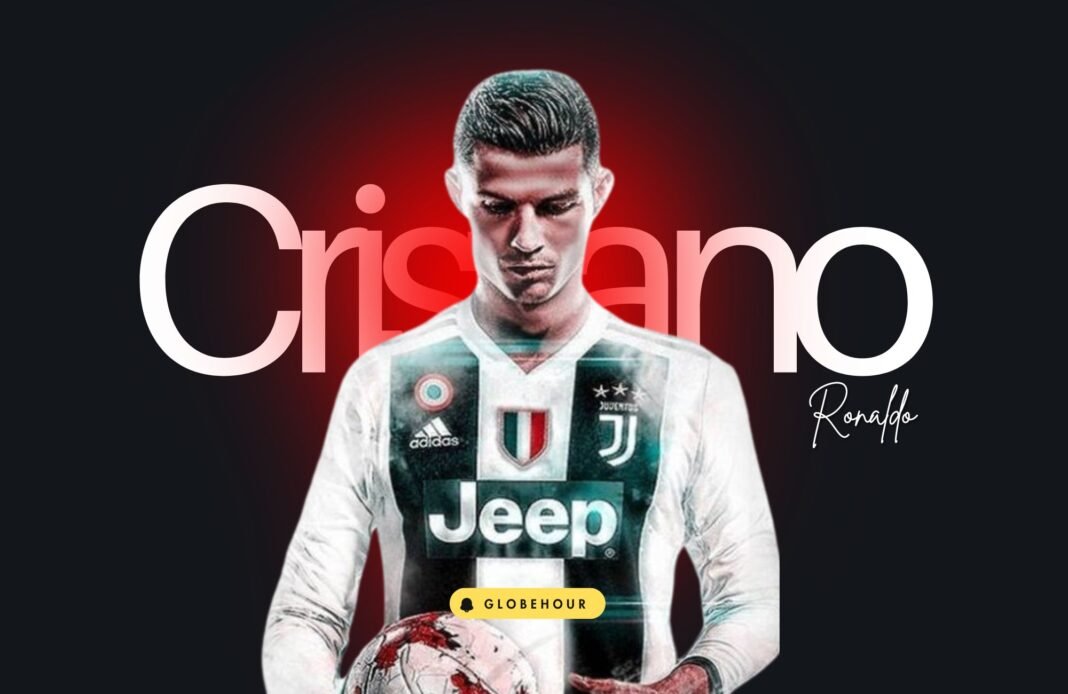
Cristiano Ronaldo dos Santos Aveiro — born February 5, 1985 in Funchal, Madeira, Portugal — is one of the two greatest footballers to ever walk this planet. Raised in a cramped house on a small island with barely enough to eat, he turned raw ambition and obsessive hard work into something the sport had never seen before: a body engineered for football, a mind wired for records, and a hunger that genuinely never switched off.
By early 2026, Cristiano Ronaldo has scored over 964 official career goals for club and country — more than any player in the history of the game. He holds the record for most international goals (143 for Portugal), most UEFA Champions League goals (140), and has won the Ballon d'Or five times. Still playing professional football aged 41 at Al Nassr in Saudi Arabia — and still scoring — his career is a story about will as much as talent.
Cristiano Ronaldo grew up in Santo António, a neighbourhood in Funchal, Madeira, in a small corrugated iron-roofed house shared with his parents and three siblings. His father José Dinis was a municipal gardener who also worked as a kit man for a local club, and his mother Maria Dolores cleaned houses and cooked in a school cafeteria. Money was tight. Food was sometimes rationed. There was nothing handed to him.
Football was everything from the start. He played for local club Andorinha as a young child, then moved to Nacional before being spotted by Sporting CP's scouts at just 12. His trial was so impressive academy coaches reportedly stopped their own sessions to watch. He left Madeira at age 12 to join Sporting's academy in Lisbon — so homesick he cried himself to sleep many nights. He let it make him harder, not softer.
Ronaldo made his senior debut for Sporting CP on August 14, 2002, at age 17 — wearing the No. 28 shirt. He played just one senior season before Manchester United came calling, but it was enough. He won his first professional trophy — the Supertaça Cândido de Oliveira in 2002 — and showed glimpses of a player operating on a different frequency to everyone around him. The step up to Old Trafford was inevitable.
Ronaldo arrived at Manchester United in summer 2003 as a teenage winger — quick, technically gifted, but raw. He wore the shirt Cantona and Beckham had worn before him: the iconic No. 7. Under Sir Alex Ferguson, he was shaped into something the game had not produced before — a winger with the build of a centre-forward, the technique of a playmaker, and the goal record of a striker. By 2007–08, he was the best player on the planet, scoring 42 goals in all competitions and winning the Champions League against Chelsea in Moscow.
He won his first Ballon d'Or in 2008. Three consecutive Premier League titles (2006–07, 2007–08, 2008–09), the 2008 Champions League, the 2008 Club World Cup, and four domestic cups made his six years at United a genuine coming-of-age story. When Real Madrid came calling with a world-record £80 million bid in 2009, even United could not say no. He returned in 2021 — a sentimental homecoming that turned complicated — but despite scoring 24 goals in a struggling team, his second chapter ended abruptly in November 2022.
Real Madrid paid a then world-record £80 million for Ronaldo in summer 2009. He delivered on every penny. Over nine years at the Bernabéu, he became the club's all-time top scorer with 450 goals in 438 appearances — a ratio that defies statistical belief. He scored 60 goals in 2011–12 alone, including 50 in La Liga to break the all-time single-season record for the division.
The Champions League became his private competition. He won it four times with Madrid — 2014, 2016, 2017, 2018 — scoring in three finals. La Décima in 2014 ended Real Madrid's 12-year wait for European glory, and Ronaldo scored the decisive penalty with tears rolling down his face. He collected four more Ballon d'Or awards during his Madrid years (2013, 2014, 2016, 2017), drawing level with Messi's tally at the time.
In July 2018, Ronaldo left Real Madrid for Juventus. At the time of departure, he had scored more goals for Real Madrid than any player in the club's 116-year history. The Bernabéu gave him a standing ovation at his farewell. He left as arguably the greatest player to ever wear the white shirt.
At €112 million, Ronaldo's move to Juventus was the most expensive transfer in Serie A history. He delivered domestically — 101 goals in 134 games, two Serie A titles, a Coppa Italia, and two Supercoppa Italiana — but the Champions League goal remained elusive despite individual brilliance. The Serie A era proved one thing: his production does not depend on the system, league, or quality of teammates.
In his final Juventus season he still scored 36 goals in all competitions and won the Capocannoniere (Serie A Golden Boot) with 29 league goals. He crossed 100 international goals for Portugal during this period, cementing his status as the greatest international scorer of all time. He left in August 2021 to return to Manchester United.
When Ronaldo joined Al Nassr in January 2023, half the football world called it a retirement move. He has since scored over 130 goals for the club — including a record-breaking 35-goal Saudi Pro League season in 2023–24, surpassing the league's all-time single-season scoring record. In the current 2025–26 season, he has already scored 21 goals and is still performing at an elite level aged 41.
He won the Arab Club Champions Cup in 2023 — scoring a brace in the final against rivals Al Hilal to hand Al Nassr their first continental title. His arrival transformed the Saudi Pro League into a globally followed competition, triggering signings of Benzema, Neymar, Firmino, and others. By early 2026, Ronaldo confirmed the upcoming 2026 FIFA World Cup will "definitely" be his last. At 41, he still reports to training among the first and still outworks players fifteen years his junior.
Ronaldo made his Portugal debut on August 20, 2003, aged 18. Over the next 22 years he became the most capped outfield player in international football history with 226+ appearances, and the all-time leading goalscorer in men's international football with 143 goals — a record he extended as recently as October 2025. He broke Ali Daei's long-standing record of 109 in 2021 and has not stopped adding to it since.
The defining international moment came at UEFA Euro 2016, where Portugal won their first major international trophy. Ronaldo himself limped off injured in the final against the hosts — and then spent the rest of the match coaching from the touchline with the intensity of a manager. Portugal won 1–0 in extra time. He lifted the trophy in tears. He also won the UEFA Nations League with Portugal in both 2019 and 2025, adding further silverware to a collection that had previously only been criticised for lacking it.
← Scroll to see full stats →
| Club / Team | Country | Period | Apps | Goals | Assists | G/Game |
|---|---|---|---|---|---|---|
| Sporting CP | 🇵🇹 Portugal | 2002–2003 | 31 | 5 | 6 | 0.16 |
| Manchester United | 🏴 England | 2003–09 + 2021–22 | 346 | 145 | 72 | 0.42 |
| Real Madrid | 🇪🇸 Spain | 2009–2018 | 438 | 450 | 131 | 1.03 |
| Juventus | 🇮🇹 Italy | 2018–2021 | 134 | 101 | 22 | 0.75 |
| Al Nassr | 🇸🇦 Saudi Arabia | 2023–Present | 140+ | 130+ | 25+ | ~0.93 |
| Portugal National | 🇵🇹 Portugal | 2003–Present | 226+ | 143 | 46+ | 0.63 |
| CAREER TOTAL | — | 2002–Present | 1,300+ | 964+ | 300+ | ~0.74 |
← Scroll to see full awards →
| Award | Times Won | Years |
|---|---|---|
| Ballon d'Or | 5 | 2008, 2013, 2014, 2016, 2017 |
| FIFA Best Male Player | 3 | 2016, 2017, 2019 |
| European Golden Shoe | 4 | 2008, 2011, 2014, 2015 |
| UCL All-Time Top Scorer | 140 Goals | Record — Unbroken |
| All-Time International Top Scorer | 143 Goals | Men's International Record |
| UEFA Best Player in Europe | 4 | 2008, 2014, 2016, 2017 |
| PFA Players' Player of the Year | 2 | 2007, 2008 |
| FIFA Puskás Award | 1 | 2009 |
| FIFA FIFPro World XI | 16 | 2007–2022 |
| Most Capped Portugal Player | 226+ | National Team Record |