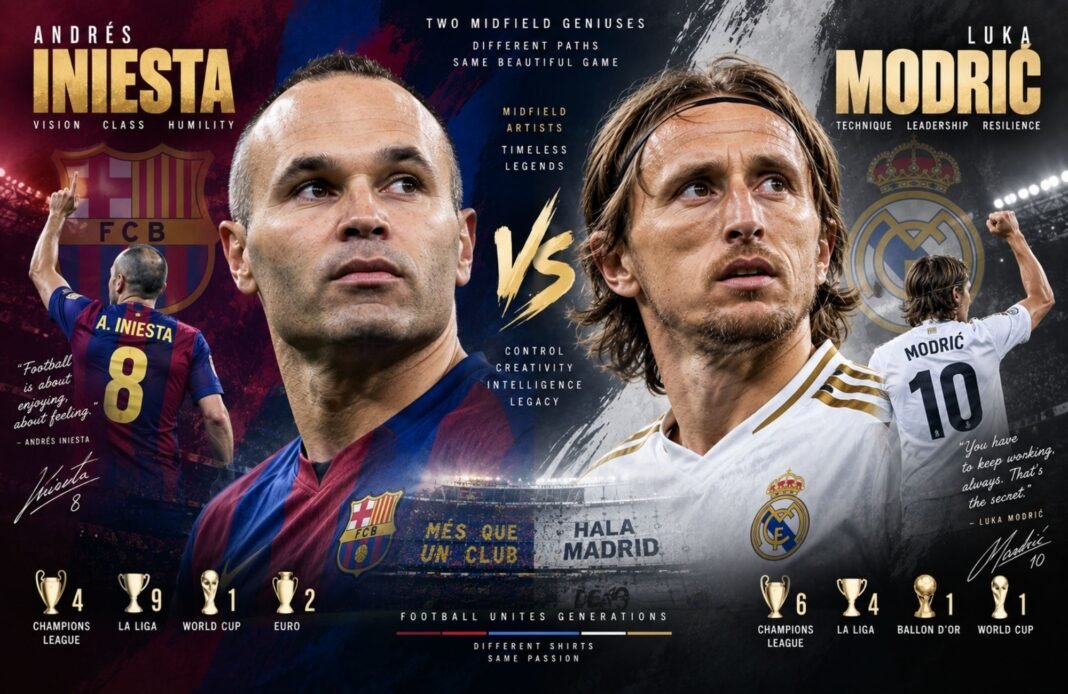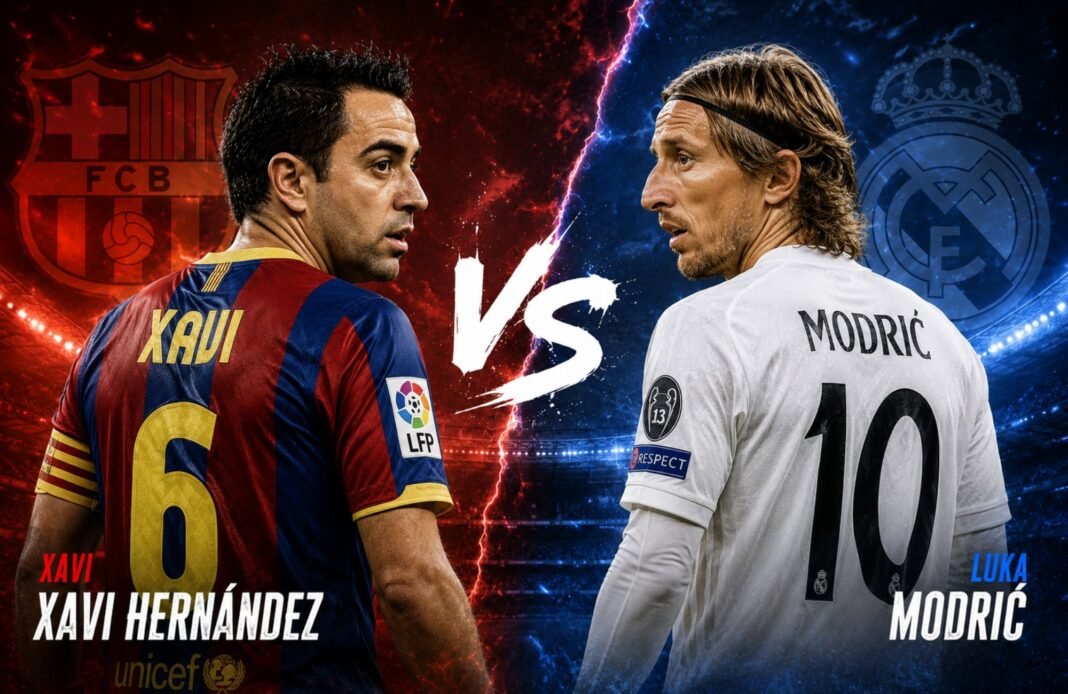
Xavi vs Luka Modrić: Some debates in football never get old. The Xavi vs Modrić argument is one of them. Two midfielders. Two different clubs. Two different countries. But both reached the very top of the game and stayed there for over a decade.
Xavi controlled football from the centre of the pitch. Modrić dominated it with energy, drive, and skill. Both changed how we think about the midfield position. Both left behind a legacy that younger players still study today.
Let’s break this down properly and see who truly comes out on top.
Career Numbers at a Glance
Xavi and Luka Modrić finished with remarkably similar club appearance totals. Xavi ended his club career with 934 matches, while Modrić has reached 936.
Their scoring records are also close. Xavi scored 112 club goals and Modrić has 99, but the larger difference appears in assists, where Xavi leads 218 to 144.
International football widens the gap in longevity. Xavi earned 133 caps for Spain, while Modrić has reached 202 appearances for Croatia and continued playing at the highest level into his 40s.
| Career Stat | Xavi | Luka Modrić |
|---|---|---|
| Club Matches | 934 | 936 |
| Club Goals | 112 | 99 |
| Club Assists | 218 | 144 |
| International Caps | 133 | 202 |
| International Goals | 12 | 29 |
| Free-Kick Goals | 16 | 2 |
| Penalties Scored | 3 | 23 |
| Ballon d’Or | 0 | 1 |
Playing Styles: How They Differed
Xavi controlled matches through positioning, awareness and short passing. He constantly moved into space, received the ball under pressure and released it before defenders could close him down.
He rarely needed long dribbles to influence a match. His strength was recognising the next action early and keeping possession moving at exactly the right speed.
Modrić influences games in a broader way. He can drop deep to receive, carry the ball through pressure, switch play over distance and still arrive in advanced areas.
Both were capable of controlling midfield, but they did so through very different methods.
The Controller
Xavi wanted the game on his terms. He slowed matches down when needed and sped them up with one quick combination.
His best work often looked simple. That was the point. He made difficult decisions early.
The All-Round Midfielder
Modrić can control possession, but he is also comfortable in a more open game. He carries the ball, presses and works across larger spaces.
That flexibility helped him stay effective under different coaches and in very different systems.
Club Career: Goals, Assists and Minutes
Most of Xavi’s club career was spent with Barcelona before he finished his playing days at Al Sadd. He ended with 934 appearances, 112 goals and 218 assists.
Modrić followed a more varied route. He developed at Dinamo Zagreb, moved to Tottenham Hotspur, became a Real Madrid legend and later joined AC Milan.
His club record now stands at 936 appearances, 99 goals and 144 assists. Xavi produced more direct assists, while Modrić has now played slightly more club football overall.
| Club Stat | Xavi | Modrić |
|---|---|---|
| Matches | 934 | 936 |
| Goals | 112 | 99 |
| Assists | 218 | 144 |
| Minutes Per Goal | 655 | 696 |
| Total Minutes | 73,343 | 68,914 |
Xavi vs Modrić at a Glance
Similar club appearance totals. Very different ways of influencing a midfield.
Club Appearances
Club Assists
Big Career Numbers
International Careers: Spain vs Croatia
Xavi made 133 senior appearances for Spain and scored 12 goals. His international peak came during one of the most successful periods in national-team history.
Spain won Euro 2008, the 2010 World Cup and Euro 2012, with Xavi playing a central role in the team’s control of possession and tempo.
Modrić has built a different kind of international legacy with Croatia. He has reached 202 caps and scored 29 goals while remaining the team’s main midfield reference for many years.
Croatia never had the same depth of talent as Spain, which makes Modrić’s run to the 2018 World Cup final and third-place finish in 2022 especially significant.
| International Stat | Xavi | Modrić |
|---|---|---|
| Senior Caps | 133 | 202 |
| Goals | 12 | 29 |
| Assists | 34 | 29 |
| Major Senior Titles | World Cup + 2 EUROs | 0 |
World Cup Performance
Xavi has the World Cup medal that Modrić never managed to win. Spain lifted the trophy in 2010 with Xavi at the centre of their midfield.
He played 15 World Cup matches and recorded two assists. His influence was based far more on control and circulation than on goals.
Modrić played 19 World Cup matches, scored twice and provided one assist. His defining tournament came in 2018, when Croatia reached the final and he won the Golden Ball.
| World Cup Stat | Xavi | Modrić |
|---|---|---|
| Matches | 15 | 19 |
| Goals | 0 | 2 |
| Assists | 2 | 1 |
| Titles | 1 | 0 |
UEFA Euro Performances
Xavi’s European Championship record is closely tied to Spain’s golden era. He helped the national team win Euro 2008 and Euro 2012.
Across 11 appearances at the tournament, he scored once and recorded four assists.
Modrić played 16 Euro matches, scoring four goals and providing one assist. Croatia produced several competitive teams during his career, but never reached the final.
| Euro Stat | Xavi | Modrić |
|---|---|---|
| Matches | 11 | 16 |
| Goals | 1 | 4 |
| Assists | 4 | 1 |
| Titles | 2 | 0 |
UEFA Champions League: Six vs Four
Both midfielders spent years at the heart of elite Champions League teams.
Xavi played 151 matches in the competition, scoring 11 goals and providing 31 assists. Modrić has 142 appearances, nine goals and 20 assists.
Xavi has the stronger creative numbers, while Modrić has the larger collection of medals. Xavi won four Champions League titles, compared with six for Modrić.
The contrast reflects their careers well. Xavi’s legacy is strongly connected to control and chance creation, while Modrić combines technical quality with exceptional longevity at the highest level.
| UCL Stat | Xavi | Modrić |
|---|---|---|
| Matches | 151 | 142 |
| Goals | 11 | 9 |
| Assists | 31 | 20 |
| Minutes Per Goal | 1,031 | 1,120 |
| Titles | 4 | 6 |
La Liga Career
Xavi still holds the stronger overall La Liga record. He played 505 league matches for Barcelona, scoring 58 goals and providing 131 assists.
Modrić completed his Real Madrid league career with 394 appearances, 30 goals and 66 assists.
Xavi also won eight La Liga titles, compared with four for Modrić. Both records are outstanding, but Xavi spent a larger part of his prime in Spain’s top division.
| La Liga Stat | Xavi | Modrić |
|---|---|---|
| Matches | 505 | 394 |
| Goals | 58 | 30 |
| Assists | 131 | 66 |
| Minutes Per Goal | 676 | 910 |
| Titles | 8 | 4 |
Premier League, Qatar and Serie A
Before becoming a Real Madrid legend, Modrić spent four seasons in the Premier League with Tottenham Hotspur. He made 127 league appearances, scoring 13 goals and providing 18 assists.
Xavi took a different path late in his career. He moved to Al Sadd and recorded 20 goals and 24 assists in 81 Qatar Stars League matches.
Modrić later added another chapter in Italy. His Serie A record with AC Milan now stands at 38 appearances, two goals and three assists.
| Competition | Player | Apps | Goals | Assists |
|---|---|---|---|---|
| Premier League | Modrić | 127 | 13 | 18 |
| Qatar Stars League | Xavi | 81 | 20 | 24 |
| Croatian League | Modrić | 111 | 31 | 21 |
| Serie A | Modrić | 38 | 2 | 3 |
Head-to-Head Record
Xavi and Modrić faced each other nine times in competitive matches.
Xavi’s side won five of those meetings, while Modrić’s team won three. One match ended in a draw.
Neither midfielder scored in those games. Xavi registered one assist, while Modrić did not record one.
That is fitting for two players whose greatest influence often came through control, positioning and build-up play rather than finishing.
| Head-to-Head Stat | Xavi | Modrić |
|---|---|---|
| Matches | 9 | 9 |
| Wins | 5 | 3 |
| Draws | 1 | 1 |
| Goals | 0 | 0 |
| Assists | 1 | 0 |
Trophy Cabinet
Both players built exceptional trophy collections, although the balance of those honours is very different.
Xavi has the stronger international record, with a World Cup and two European Championships for Spain.
Modrić’s most impressive achievements came in European club football. Six Champions League titles, five UEFA Super Cups, four Club World Cups and one Intercontinental Cup form the core of his collection.
| Trophy | Xavi | Modrić |
|---|---|---|
| La Liga | 8 | 4 |
| Copa del Rey | 3 | 2 |
| Champions League | 4 | 6 |
| UEFA Super Cup | 2 | 5 |
| FIFA Club World Cup | 2 | 4 |
| FIFA Intercontinental Cup | 0 | 1 |
| FIFA World Cup | 1 | 0 |
| UEFA EURO | 2 | 0 |
| Spanish Super Cup | 6 | 5 |
Individual Awards
Modrić owns the biggest individual honour in this comparison after winning the Ballon d’Or in 2018.
He also won The Best FIFA Men’s Player and the UEFA Best Player in Europe award.
Xavi never won the Ballon d’Or, despite being one of the most influential players in Barcelona and Spain’s greatest teams.
Individual awards never tell the complete story, but Modrić clearly has the stronger record in this category.
| Award | Xavi | Modrić |
|---|---|---|
| Ballon d’Or | 0 | 1 |
| The Best FIFA Men’s Player | 0 | 1 |
| UEFA Best Player in Europe | 0 | 1 |
| Footballer of the Year | 1 | 0 |
| Player of the Year | 1 | 2 |
Free Kicks vs Penalties
Set-piece numbers reveal another clear difference between the two midfielders.
Xavi scored 16 direct free kicks during his career, while Modrić scored two.
The pattern changes from the penalty spot. Modrić converted 23 of 29 attempts, while Xavi scored three from five.
| Dead-Ball Stat | Xavi | Modrić |
|---|---|---|
| Free-Kick Goals | 16 | 2 |
| Penalties Taken | 5 | 29 |
| Penalties Scored | 3 | 23 |
| Penalty Conversion | 60% | 79% |
Longevity: Modrić Keeps Going
Xavi retired in 2019 after completing his playing career with Al Sadd.
Modrić continued for much longer. He joined AC Milan in 2025 and remained active in top-flight football into his 40s.
His Serie A record now stands at 38 appearances, two goals and three assists, while he has also reached 202 senior caps for Croatia.
That level of longevity is unusual for any player, especially for a midfielder who has spent so many years covering large areas of the pitch.
Xavi vs Luka Modrić: The Final Picture
Xavi’s strongest argument is built around control, creativity and international success. His assist record, La Liga numbers and achievements with Spain all support that case.
Modrić’s career tells a different story. He has played longer, adapted to more tactical systems and collected six Champions League titles along the way.
Xavi gave his teams rhythm and structure. Modrić offered greater range, carrying ability and flexibility across different types of matches.
That is why the comparison remains so compelling. They were not similar midfielders competing for the same legacy. They were two different versions of elite midfield play.
Two Midfield Legends, Different Strengths
Xavi: more club assists, eight La Liga titles, a World Cup and two European Championships.
Modrić: six Champions League titles, a Ballon d’Or, 202 Croatia caps and remarkable longevity.
The debate lasts because their greatness did not look the same.
Xavi vs Luka Modrić FAQs
Who has played more matches, Xavi or Modrić?
Modrić has played more overall. He has 936 club appearances and 202 senior caps for Croatia, while Xavi finished with 934 club matches and 133 appearances for Spain.
Who has more assists?
Xavi has the stronger club assist record. He finished with 218 assists, compared with 144 for Modrić. Chance creation from central midfield was one of Xavi’s defining strengths.
Who won more Champions League titles?
Modrić won six Champions League titles, while Xavi won four. Xavi recorded more assists in the competition, but Modrić finished with the larger medal collection.
Who won more La Liga titles?
Xavi won eight La Liga titles with Barcelona. Modrić won four with Real Madrid.
Who had the stronger international trophy record?
Xavi has the stronger international trophy record. He won the World Cup and two European Championships with Spain. Modrić led Croatia to the 2018 World Cup final, but did not win a major senior international title.
Did Xavi or Modrić win the Ballon d’Or?
Modrić won the Ballon d’Or in 2018. Xavi never won the award, despite being a key figure in Barcelona and Spain’s most successful teams.
What is their head-to-head record?
They faced each other nine times. Xavi’s side won five matches, Modrić’s side won three and one game ended in a draw. Neither player scored, while Xavi recorded one assist.
What is the biggest difference between Xavi and Modrić?
Xavi was a specialist in controlling tempo through short passing and positioning. Modrić offered greater carrying ability, defensive involvement and adaptability across different tactical systems.