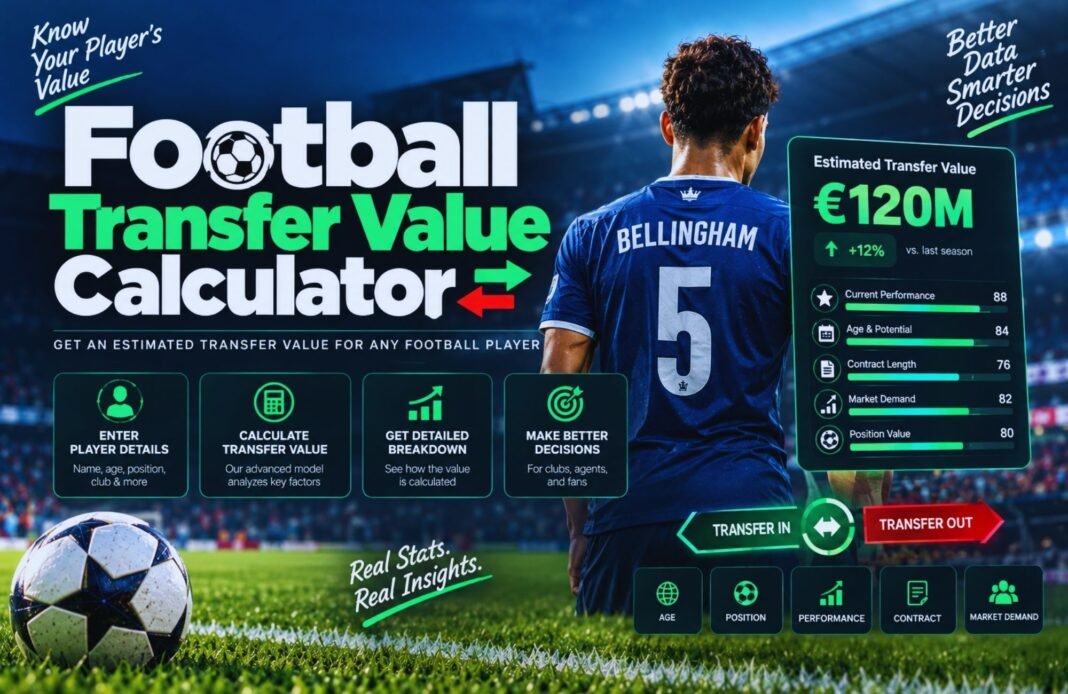
Want to see how well a player performed in a match? Our Football Player Rating Calculator uses key performance stats to estimate an overall player rating. It’s a quick way to evaluate performances, compare players, and track form over time.
Football Player Rating Calculator
Estimate a 1–10 football match rating for an attacker, midfielder, defender or goalkeeper using role-specific match statistics.
Football Player Rating Calculator
Choose a position, rate the main performance areas from 0 to 10, then calculate one estimated match rating.
Estimate A Football Match Rating
One form only. No tabs and no hidden position panels.
Examples: error leading to goal or major match-changing mistake.
How The Football Player Rating Calculator Works
Each role starts from a neutral 6.0 baseline and adds or subtracts small weighted adjustments from position-relevant match events.
Football Player Rating Calculator: What The Score Means
This calculator creates an educational 1–10 estimate from a small set of match statistics. It does not replace video analysis, professional scouting or coaching assessment.
Off-ball movement, pressing, positioning, communication and tactical decisions can materially affect performance without appearing in basic box-score inputs.
Football Player Rating Calculator Inputs Explained
The one-form calculator stays simple, but each input represents a different part of match performance. Use the same 0–10 standard for every performance field.
| Input | What To Consider | High Score Usually Means | Common Mistake To Avoid |
|---|---|---|---|
| Attacking Impact | Goals, shooting threat, chance involvement, dribbling and dangerous movement. | The player consistently influenced the opponent’s goal or defensive structure. | Do not give 9 or 10 only because the player scored once. |
| Passing & Creativity | Progression, chance creation, pass selection, ball security and useful distribution. | The player moved the team forward and created valuable possession or chances. | Do not rate only from raw pass-completion percentage. |
| Defensive Impact | Tackles, interceptions, duels, positioning, blocks, recovery and pressing contribution. | The player repeatedly prevented danger or helped regain control. | High tackle totals do not automatically mean good positioning. |
| Work Rate / Physical Impact | Intensity, repeated effort, pressing, transitions, duels and physical influence. | The player maintained strong involvement across phases. | Do not confuse running a lot with running effectively. |
| Goalkeeping Impact | Saves, claiming, sweeping, distribution and goal-prevention actions. | The goalkeeper had a major positive effect on preventing or managing danger. | Outfield players should normally enter 0 here. |
| Major Mistakes | Errors that clearly create major danger or significantly damage the team. | This is a count, not a quality score; a higher number lowers the rating. | Do not count every misplaced pass as a major mistake. |
Football Player Rating Scale From 1 To 10
The scale below belongs to this GlobeHour calculator. Different media outlets, analytics providers and clubs can use different scales.
| Rating | Performance Band | General Interpretation | How Often It Should Be Used |
|---|---|---|---|
| 9.0–10.0 | Outstanding | Match-defining or exceptional performance with very few meaningful weaknesses. | Rarely. |
| 8.0–8.9 | Excellent | Major positive influence with strong execution in the main role. | Clearly high-level performances. |
| 7.0–7.9 | Strong | Above-normal contribution with more positives than negatives. | Good performances. |
| 6.0–6.9 | Solid | Generally acceptable performance without major match-defining influence. | Normal positive matches. |
| 5.0–5.9 | Below Average | Limited influence, several weak areas or an important negative moment. | Below role expectations. |
| 1.0–4.9 | Poor | Serious negative impact, repeated problems or major mistakes. | Use cautiously and only with clear evidence. |
Football Player Rating Weighting By Position
The calculator changes the importance of each performance area after you select a position.
| Position | Attacking | Passing | Defending | Work Rate | Goalkeeping |
|---|---|---|---|---|---|
| Attacker | 50% | 22% | 6% | 20% | 2% |
| Midfielder | 22% | 38% | 18% | 20% | 2% |
| Defender | 8% | 18% | 48% | 24% | 2% |
| Goalkeeper | 2% | 16% | 12% | 15% | 55% |
Important: These percentages are GlobeHour calculator assumptions, not official FIFA, league or scouting weights.
How To Rate An Attacker Fairly
Attackers receive the strongest weight on attacking impact, but a fair rating should look beyond whether the player scored. A forward can play well by repeatedly threatening the defensive line, creating space, linking attacks and pressing effectively even if the final goal contribution never arrives.
Attacking Impact
A high score should normally reflect repeated influence in dangerous areas. Goals matter, but so do shots created, dribbles that break pressure, useful runs and actions that force defenders to react. One easy tap-in should not automatically produce a 9 or 10 if the player contributed very little elsewhere.
Passing And Combination Play
Modern forwards often participate in build-up. Layoffs, through balls, switches, cutbacks and combinations can be valuable even when they do not become official assists. Use the passing score to capture this broader creative contribution.
Work Rate
Pressing and recovery runs can be important depending on the tactical role. The calculator gives work rate a meaningful but smaller weight than direct attacking impact.
How To Rate A Midfielder Fairly
Midfielders can have the most varied responsibilities on the pitch. A defensive midfielder may protect space and control transitions, while an attacking midfielder may be judged more heavily on chance creation. The calculator therefore gives passing and creativity the highest weight while still rewarding attacking, defensive and physical contribution.
Do Not Judge Passing By Completion Percentage Alone
A player who makes only safe short passes may finish with a very high completion rate but have limited influence. Another midfielder may lose the ball more often because they attempt line-breaking passes and difficult final-third actions. Quality and purpose matter as much as raw completion.
Defensive Midfielders
Positioning can be more important than tackle volume. A well-positioned midfielder may close passing lanes and prevent attacks before a tackle becomes necessary. That type of performance should be reflected in the defensive impact score even if the box score looks quiet.
Creative Midfielders
For attacking midfielders, receiving between the lines, turning under pressure, creating chances and linking with forwards are major parts of the role. Use the passing and attacking scores together to represent that influence.
How To Rate A Defender Fairly
Defenders receive the strongest weight on defensive impact, but tackles and clearances should never be read in isolation. A team that controls possession may give its defenders fewer opportunities to record defensive actions, while a team under constant pressure can produce very high tackle and clearance totals.
Positioning Before Tackling
Excellent defending often prevents an event from happening. Good body position, spacing, communication and anticipation can stop a dangerous pass without producing a tackle or interception statistic.
Duels And Emergency Defending
Winning important aerial or ground duels can be valuable, especially near goal or during transitions. Blocks and clearances also matter, but their value depends on difficulty and game state.
Build-Up Contribution
Modern defenders can influence possession through progressive passing, carrying and composure under pressure. That is why the calculator keeps a meaningful passing weight rather than treating defenders only as ball winners.
How To Rate A Goalkeeper Fairly
Goalkeepers are difficult to rate from basic statistics because save difficulty varies enormously. Five routine saves are not necessarily more valuable than two outstanding stops from high-quality chances. Use the goalkeeping impact score to reflect quality, not just quantity.
Shot Stopping
Consider how difficult the saves were, whether they prevented clear goals and how important they were to the match. A goalkeeper who concedes can still play very well if the goals were nearly impossible to stop.
Distribution
Passing can be a major part of modern goalkeeping. Look at decision-making, range, accuracy under pressure and whether distribution helps the team progress rather than relying only on completion percentage.
Area Control And Sweeping
Claiming crosses, controlling space behind a high defensive line and communicating with defenders can all influence performance even when they do not appear clearly in a simple statistical summary.
Major Mistakes And Their Effect On A Football Player Rating
The Major Mistakes field is designed for serious negative events, not every small technical error. Each major mistake subtracts 0.45 points from the weighted score. That is enough to matter without automatically erasing an otherwise strong performance.
Examples might include an error that directly gifts the opponent a goal, a reckless decision that creates an obvious scoring chance, or another major action with a clear negative effect on the match. A slightly misplaced pass in midfield should normally not be counted.
One Major Mistake
A single serious error can move an 8.0-level performance closer to 7.6. The player may still have played well overall, but the mistake should be visible in the final rating.
Several Major Mistakes
Repeated serious errors create a much larger deduction. Three major mistakes remove 1.35 points before the final score is limited to the 1–10 range.
Use this field carefully: over-counting small mistakes will make the final rating artificially low.
Example Football Player Ratings
These examples show how position changes the interpretation of the same broad performance areas.
| Example Player | Key Input Pattern | Likely Rating Direction | Reason |
|---|---|---|---|
| Attacker A | Attack 9, Passing 7, Defense 3, Work 8 | High | The attacker model gives the strongest weight to attacking impact. |
| Midfielder B | Attack 7, Passing 9, Defense 7, Work 8 | High | Strong passing plus balanced contribution fits the midfielder weighting. |
| Defender C | Attack 4, Passing 7, Defense 9, Work 8 | High | Defensive impact dominates the defender weighting. |
| Goalkeeper D | GK 9, Passing 7, Work 7, Defense 6 | High | Goalkeeping impact carries more than half of the goalkeeper model. |
What A Simple Football Player Rating Cannot Measure Completely
Football is an interactive team sport, so a single numerical rating can never capture every responsibility. The calculator is most useful when the input scores already reflect careful observation rather than being based only on a few headline statistics.
Off-Ball Movement
A forward can create space with a run without touching the ball. A midfielder can drag an opponent away from a passing lane. These actions may be tactically important even when they never appear in the box score.
Pressing And Team Structure
Good pressing depends on timing and coordination. A player can run aggressively but damage the team shape, while another player can press less often but choose better moments. Raw distance covered does not explain that difference.
Opponent Strength And Game State
A performance against an elite opponent may be more difficult than the same statistical output against weaker opposition. Responsibilities also change when a team is protecting a lead, chasing a goal or playing with ten players.
Tactical Role
Two players listed at the same position may have completely different jobs. One full-back may overlap constantly while another stays deeper. One midfielder may be asked to take risks while another protects possession. Use role context when choosing the 0–10 input scores.
How To Compare Football Player Ratings Fairly
- Use the same 0–10 scoring standard for every player.
- Compare players in similar roles whenever possible.
- Do not compare one player’s best match with another player’s average match.
- Keep opponent and competition strength in mind.
- Use the mistake count only for genuinely major errors.
- For outfield players, normally enter 0 for Goalkeeping Impact.
- Use match video to check things the calculator cannot see.
- For season analysis, calculate multiple matches rather than relying on a single result.
Related GlobeHour Football Tools
Football Player Rating Calculator Methodology & Sources
The weights are GlobeHour editorial assumptions for educational comparison. Different football data providers can use different definitions, event models and proprietary rating systems.
Football Player Rating Calculator FAQ
Is this an official FIFA player rating?
No. It is a GlobeHour educational estimate.
Why are there four modes?
Different positions perform different jobs, so attackers, midfielders, defenders and goalkeepers need different inputs.
Can I compare players in different positions?
You can, but the calculator applies different position weights. Treat cross-position comparisons as broad context rather than a direct ranking of who is better.
Should an outfield player receive a goalkeeping score?
Normally no. Enter 0 for Goalkeeping Impact unless the player actually performed meaningful goalkeeper duties.
How should I use the Major Mistakes field?
Count only major negative events with a clear effect on the match, such as an error leading directly to a goal.
Can I download the result?
Yes. The result includes a PDF download with “Generated by GlobeHour.com”.