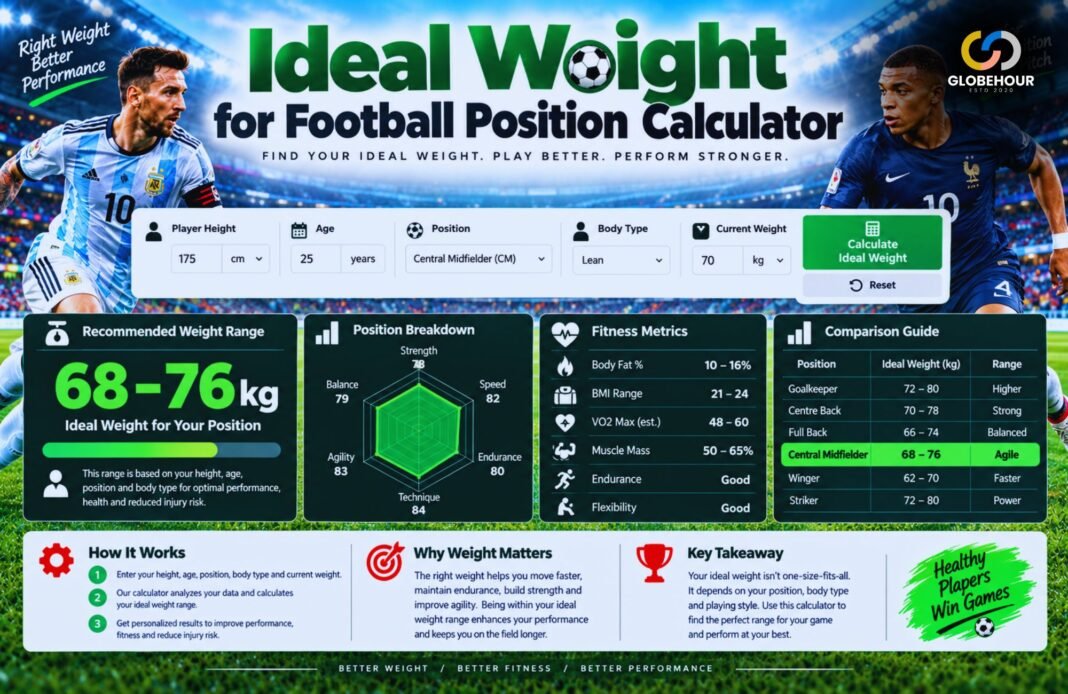
The Ideal Weight for Football Position Calculator helps you estimate a suitable playing weight based on your football position, height, and body build. Whether you play as a goalkeeper, defender, midfielder, or forward, it gives you a useful starting point for understanding your physical goals and improving your performance on the pitch.
Ideal Weight For Football Position
Find the typical playing weight for your height and position. Based on the body measurements of professional players, it shows the ideal weight range for goalkeepers, defenders, midfielders and forwards, and how your weight compares.
- Position
- Height And Weight
- Ideal Weight
What Position Do You Play?
Each position has a slightly different typical build.
Enter Your Height
Height is all you need. Add your weight to see how you compare.
Please enter a height between 140 and 220 cm (4′ 7″ to 7′ 3″), and a weight between 35 and 200 kg if you add one.
This is a general guide for adult players based on the body measurements of professional male footballers. It is not medical advice. Talk to a doctor or sports dietitian before making big changes to your weight.
How Much Do Professional Footballers Weigh By Position?
Goalkeepers are the tallest and heaviest, midfielders the lightest. Their BMI is surprisingly similar.
How The Ideal Weight Calculator Works
Four quick steps to your ideal playing weight.
Pick Your Position
Choose goalkeeper, defender, midfielder or forward.
Enter Your Height
Add your weight too if you want a comparison.
See Your Range
Get your ideal range, target weight and every position.
Use It Wisely
Treat it as a guide alongside fitness and strength.
What Is The Ideal Weight For A Football Position?
There is no single perfect weight for a footballer, because taller players naturally weigh more. A better question is: for my height, what do players in my position usually weigh? That’s what this calculator answers.
It uses the average body mass index (BMI) of professional players in each position and applies it to your height. The result is a typical weight range for your position, a target weight in the middle, the same figures for every other position and, if you add your weight, how far you are from the range.
How The Ideal Weight Is Calculated
Example: a midfielder who is 180 cm tall and weighs 76 kg.
| Step | Formula | Example |
|---|---|---|
| Height Squared | Height (m) × height (m) | 1.80 × 1.80 = 3.24 |
| Target Weight | Position BMI × height squared | 22.16 × 3.24 = 71.8 kg |
| Ideal Range | (Position BMI ± 1.0) × height squared | 68.6 to 75.0 kg |
| Your BMI | Weight ÷ height squared | 76 ÷ 3.24 = 23.5 |
| Vs Target | Your weight − target weight | 76 − 71.8 = +4.2 kg |
The position BMIs come from the study in the figure: goalkeepers 22.82, defenders 22.43, forwards 22.43 and midfielders 22.16. The ± 1.0 range is GlobeHour’s simple guide to allow for different body types.
Why Weight Differs By Position
- Goalkeepers are usually the tallest and heaviest players. Size helps them cover the goal and command their area.
- Defenders need size and strength for headers, blocks and physical battles with strikers.
- Midfielders are usually the lightest, which suits the huge amount of running they do every match.
- Forwards need a mix of power to hold off defenders and speed to get in behind.
Interestingly, BMI changes much less than weight between positions. Most of the difference in weight comes from height, which is why this calculator works from your height.
What BMI Can And Can’t Tell You
BMI is a quick way to compare weight with height, but it can’t tell muscle from fat. Footballers often carry more muscle than average, so a fit player can have a higher BMI than the range suggests. For a clearer picture, a coach or sports scientist can measure body composition.
For adults in general, a BMI from 18.5 to 24.9 is considered a healthy weight range. The calculator shows this range for your height too, so you can see both the football range and the general health range.
Tips For A Healthy Playing Weight
- Focus on performance, such as speed, strength and stamina, more than the scale.
- Eat regular, balanced meals, especially around training and matches.
- Drink plenty of water before, during and after exercise.
- Do strength training to build muscle that helps in duels.
- Get enough sleep so your body can recover and adapt.
- Make any weight changes slowly over weeks, not days.
- Ask a sports dietitian for a plan that suits your position.
- Check your weight at the same time of day for a fair comparison.
Ideal Weight For Football Position FAQ
What Is The Ideal Weight For A Footballer?
It depends on your height and position. For a 180 cm midfielder, the typical range is about 68.6 to 75.0 kg. Use the calculator for your own height.
Is The Ideal Weight Calculator Free?
Yes. It is completely free, needs no sign-up and works on phones, tablets and computers.
Which Position Is The Heaviest?
Goalkeepers. In the study used here, professional goalkeepers averaged 85.8 kg and 194.3 cm.
Which Position Is The Lightest?
Midfielders. In the same study, they averaged 73.3 kg and 181.7 cm.
How Is The Ideal Weight Worked Out?
The calculator multiplies the average BMI of professional players in your position by your height in metres squared, and adds a range of ± 1.0 BMI.
Can I Use Feet And Pounds?
Yes. Choose Feet and lb in step one and enter your height in feet and inches.
Does It Work For Women Or Children?
The data comes from adult male professional players, so it is only a rough guide for women. Children and teenagers should use age-based growth charts with a doctor instead.
What If I’m Above The Range?
That may be fine if the extra weight is muscle. If you want to change your weight, do it slowly and talk to a coach, doctor or sports dietitian.
Is My Information Saved?
Your details are saved only in your own browser. Nothing is sent to GlobeHour.
Related GlobeHour Football Tools
Ready To Find Your Ideal Playing Weight?
Pick your position, enter your height and see your ideal range in seconds.
Open The Ideal Weight Calculator