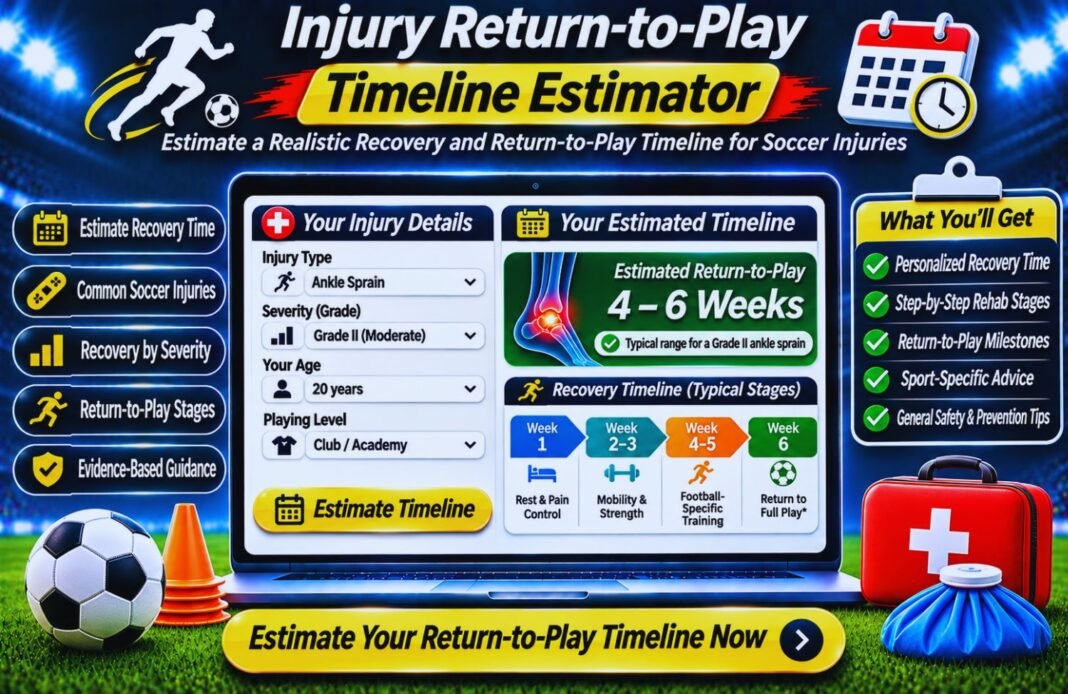
Estimate a possible recovery and return-to-play timeline with our free Injury Return-to-Play Timeline Estimator. Explore general recovery ranges based on injury type and severity, while understanding that medical clearance is essential before returning to football.
Injury Return-To-Play Timeline Estimator
Injured and wondering when you can play again? Pick your injury and how bad it is, add your age, level and rehab, and this free estimator builds your return to play timeline. You get an earliest, typical and cautious match date, dated rehab phases with clear checks to move on, a readiness checklist, a pain log and a PDF you can share with your coach or physio.
- Injury
- Player
- Your Timeline
What’s The Injury?
Choose the closest match. Not sure? A physio or doctor can confirm the injury and grade.
🧠 Suspected concussion? Stop playing straight away and don’t return the same day. If in doubt, sit them out. Get urgent help for a worsening headache, repeated vomiting, confusion or a seizure.
About The Player
These answers change your return to play timeline the most.
This is an estimate for education, not medical advice. Your ticks and pain log are saved in this browser only. Always follow your doctor or physiotherapist and never play through pain.
Return To Play Timeline For Common Football Injuries
How long the most common football injuries usually keep you out.
Build Your Return To Play Timeline In 3 Steps
Your return to play timeline takes less than a minute to build.
Pick The Injury
Choose the injury and how bad it is.
About You
Add age, level, past injuries, rehab and the injury date.
Follow The Phases
Tick each phase’s checks and log your pain.
Get Cleared
Finish the readiness checklist before a match.
Why Use A Return To Play Timeline?
The hardest part of an injury is not knowing. Players come back too early because they feel fine, or they rest for weeks when gentle exercise would have healed them faster. A return to play timeline gives you a realistic target and, more importantly, the steps that get you there safely.
This estimator starts with typical time out reported in football research, then adjusts it for things that make a real difference: older players and re-injuries take longer, while daily rehab with a physio usually shortens recovery. It splits your return to play timeline into phases, from protecting the injury to full team training, and gives each phase a goal, exercises and simple checks to pass before you move on.
Typical Recovery Times By Injury
Adult club players with good rehab. Your own return to play timeline may be shorter or longer.
| Injury | Grade / Type | Typical Return | Usual Range |
|---|---|---|---|
| Ankle sprain | Grade 1 (mild) | About 10 days | 5 to 14 days |
| Ankle sprain | Grade 2 (moderate) | About 3 weeks | 2 to 5 weeks |
| Hamstring strain | Grade 1 | About 2 weeks | 1 to 3 weeks |
| Hamstring strain | Grade 2 (partial tear) | About 3.5 weeks | 2.5 to 6 weeks |
| Hamstring strain | Grade 3 (complete tear) | About 12 weeks | 8 to 17 weeks |
| Groin (adductor) strain | Grade 2 | About 4 weeks | 2 to 6 weeks |
| Calf strain | Grade 2 | About 3.5 weeks | 2 to 6 weeks |
| Knee MCL sprain | Grade 2 | About 5 weeks | 3 to 7 weeks |
| Concussion | Symptoms clear in 2 weeks | Day 21 at the earliest | 21 to 28 days |
| Metatarsal fracture | Non-displaced | About 8 weeks | 6 to 12 weeks |
| Meniscus tear | Repaired | About 5 months | 4 to 6 months |
| ACL injury | Reconstruction | About 10 months | 9 to 12 months |
The Stages Of Every Return To Play Timeline
The same 5 stages, whether you are out for 10 days or 10 months.
1. Protect
First daysCalm pain and swelling. Keep moving gently where it doesn’t hurt.
- Move on: walking without a limp
2. Restore Movement
Range & fitnessGet full movement back and keep fit on a bike or in the pool.
- Move on: full, pain-free movement
3. Build Strength
The key phaseStrength protects you from re-injury. Add load every week.
- Move on: strength close to the other side
4. Running & Ball Work
Speed & skillsBuild up to full sprints, sharp turns, jumps and shooting.
- Move on: full speed without pain
5. Full Training
Then the matchTrain fully with the team before you play a match.
- Play when: every readiness check is ticked
Concussion: The Day 21 Rule
Concussion has its own return to play timeline.
The UK concussion guidelines for grassroots sport use six stages: relative rest for 24 to 48 hours, normal daily activities, light exercise, non-contact training, full contact training and, finally, matches. Full contact training can start from day 15 at the earliest, and only after 14 days with no symptoms at rest. A competitive match is never before day 21, counting the day of the concussion as day 0.
4 Things That Change Your Recovery Time
The estimator adjusts your return to play timeline for each of these.
Previous Injury
About +25%Football studies show re-injuries keep players out longer than the first injury.
Guided Rehab
About −10%A physio-led plan gets most players back sooner and lowers re-injury risk.
Level
Pros return soonerAcademy and pro players rehab every day. Casual players train less, so they need longer.
Age
35+ about +15%Tissues heal a little slower with age. Young players’ bones and growth plates need extra care.
Stay On Track With Your Rehab
Habits that keep your return to play timeline on schedule.
- Start gentle, pain-free movement early. Total rest usually slows healing.
- Use the 3 out of 10 rule: a little discomfort is fine if it settles by the next morning.
- Never skip strength work. It is the best protection against re-injury.
- Keep the rest of your body fit with a bike, pool or upper-body work.
- Sleep 8 hours or more and eat enough protein to help tissue repair.
- Compare the injured side with the other side for movement, strength and hops.
- Share your return to play timeline PDF with your coach so they know when to expect you.
- Train fully with the team before you play a match.
- Keep doing your injury-prevention exercises after you return.
Return To Play Timeline FAQ
What Is A Return To Play Timeline?
A return to play timeline is a plan that shows how long an injury usually takes to heal and the steps between getting injured and playing a match again. This estimator gives you dates for each phase of rehab and a typical match return date.
How Accurate Is This Return To Play Timeline Estimator?
It uses typical recovery times reported in sports medicine research, adjusted for your age, level, previous injuries and rehab. It gives a realistic range, not a promise. Your physio or doctor can examine you and should always have the final say.
How Long Does A Hamstring Strain Take To Heal?
In professional football, mild hamstring strains averaged about 2 to 3 weeks out, partial tears about 3 weeks and complete tears more than 10 weeks. Grassroots players often take a little longer because they do less daily rehab.
When Can I Play After A Concussion?
Under the UK concussion guidelines for grassroots sport, you should not play a match until at least day 21 after the concussion, and only after 14 days with no symptoms at rest and symptom-free full training. Symptoms lasting more than 28 days need a medical review.
How Long After ACL Surgery Can I Play Football?
Usually 9 to 12 months. Research found that returning before 9 months, or without passing strength and hop tests, greatly increases the chance of another knee injury. The return to play timeline for an ACL never shows a date earlier than 9 months.
Why Do Re-Injuries Take Longer?
A muscle or ligament that has been hurt before has more scar tissue and is often weaker. Studies of football players show longer time out after a re-injury, so the estimator adds about 25% when you have had the same injury before.
Can I Speed Up My Recovery?
Yes, within limits. Start gentle, pain-free movement early, follow a structured rehab plan, build strength steadily, sleep well and eat enough protein. Resting completely and then rushing back is the slowest and riskiest way.
What Does The Pain Log Do?
You score your pain from 0 to 10 after activity each day. A pain score of 3 or less that settles by the next morning usually means you can keep progressing. If the trend goes up, ease off and speak to a physio.
Is This Return To Play Timeline Medical Advice?
No. It is an educational guide. Every injury is different. If you can’t bear weight, your joint feels unstable, swelling is getting worse or you have concussion warning signs, see a doctor straight away.
Can I Save Or Print My Timeline?
Yes. Your timeline, checklist ticks and pain log are saved in your browser. You can download a PDF to share with your coach or physio, add rehab milestones to your phone calendar, or copy a short summary.
Sources: Ekstrand et al., BJSM (2012), hamstring injuries and MRI · Grindem et al., BJSM (2016), return to sport after ACL reconstruction · UK Concussion Guidelines for Non-Elite (Grassroots) Sport · Ekstrand et al., BJSM (2020), time to return in professional football.
Related GlobeHour Football Tools
More free tools to use alongside your return to play timeline.
Know When You’ll Be Back
Build your free return to play timeline and follow it phase by phase.
Estimate My Return