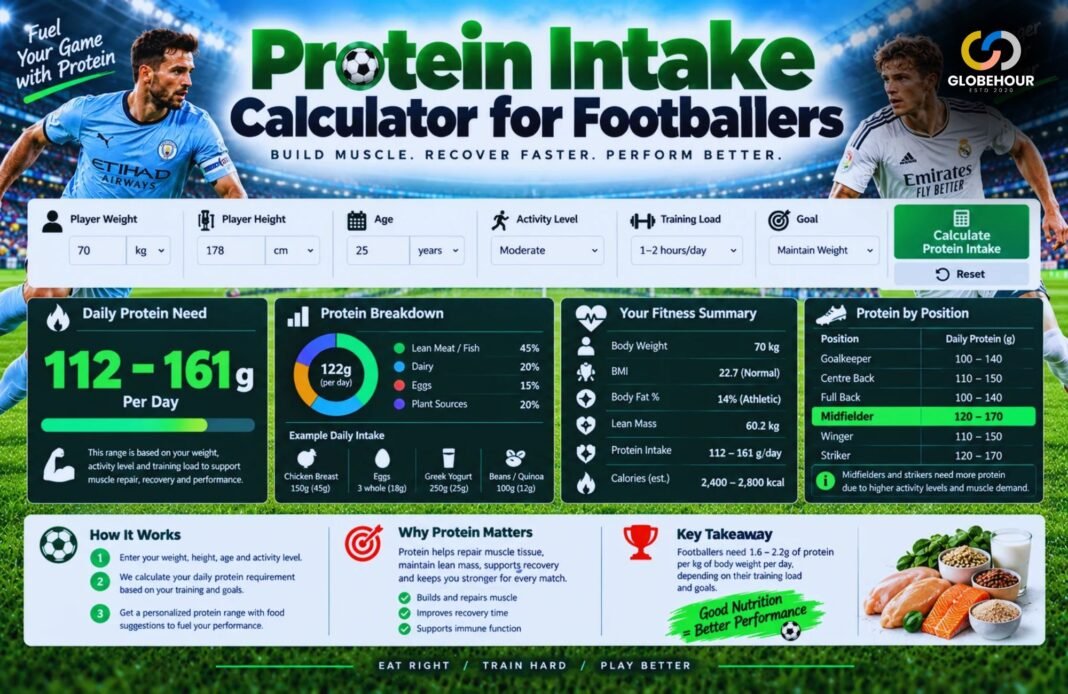
The Protein Intake Calculator for Footballers helps you estimate how much protein you need each day to support muscle recovery, strength, and performance. Whether you’re training regularly or preparing for match day, it gives you a simple daily protein target based on your body weight and activity level.
Protein Intake Calculator For Footballers
Find out how much protein you need each day for your weight, goal and stage of the season. Get your daily total, a simple meal-by-meal plan, recovery targets and what that looks like in real food.
- Position
- Weight And Goal
- Protein Plan
What Position Do You Play?
Your position shapes the advice. Your weight and goal set the numbers.
Enter Your Weight And Goal
Protein needs are worked out from your body weight.
Please check your details.
This is a general guide for healthy players based on sports nutrition research. It is not medical advice. If you have a medical condition, talk to a doctor or sports dietitian first.
How Much Protein Do Footballers Need?
Most adult players need 1.6 to 2.2 g of protein per kg of body weight each day.
How The Protein Calculator Works
Four quick steps to your daily protein plan.
Pick Your Position
Add your season phase and units.
Enter Your Weight
Choose your goal and how many servings you eat.
Get Your Plan
See your daily total, per-meal split and recovery targets.
Download Your Plan
Save it as a PDF to print or share with your coach.
Why Protein Matters For Footballers
Every training session and match causes small amounts of muscle damage, especially from sprints, jumps, tackles and changes of direction. Protein gives your body the building blocks to repair that damage, adapt to training and keep the muscle that makes you fast and strong.
Footballers need more protein than people who don’t train, but it doesn’t need to be extreme. What matters most is getting enough each day and spreading it across your meals, rather than eating one huge portion at dinner.
This calculator works out a daily target from your body weight and goal, adjusts it a little for the stage of the season, then splits it into servings and shows you what a serving looks like in everyday food.
How Your Protein Target Is Calculated
Example: a 24-year-old midfielder, 75 kg, in-season, goal “Perform”, 3 meals plus a bedtime snack.
| Step | Formula | Example |
|---|---|---|
| Goal Rate | Perform 1.8, build muscle 2.0, rehab 2.0, lose fat 2.2 g/kg | 1.8 g/kg |
| Season Adjustment | Pre-season +0.1, in-season 0, off-season −0.1 g/kg (kept inside the goal range) | 1.8 + 0 = 1.8 g/kg |
| Daily Target | Rate × weight, rounded to the nearest 5 g | 1.8 × 75 = 135 g |
| Daily Range | Goal range × weight | 1.6–2.0 × 75 = 120–150 g |
| Per Serving | Daily target ÷ servings | 135 ÷ 4 ≈ 34 g |
| Per Meal Guide | 0.4 × weight | 0.4 × 75 = 30 g |
So this player aims for about 135 g a day: roughly 34 g at breakfast, lunch and dinner, and 33 g before bed. Players under 18 get a target of 1.5 g/kg, in line with the UEFA guidance of up to 1.6 g/kg for junior players.
When Should Footballers Eat Protein?
Every Main Meal
0.4 g per kgSpread protein across 3 to 4 meals a day. Each meal should have a good portion, about 30 g for a 75 kg player.
- Breakfast: eggs, Greek yoghurt or milk
- Lunch and dinner: chicken, fish, beef, lentils or paneer
After Training
Within a couple of hoursA protein-rich meal or snack after training helps muscles start repairing. Pair it with carbohydrate to refill energy stores.
- Quick options: chocolate milk, yoghurt, a chicken wrap
- Tip: keep a snack in your bag for long journeys
After Matches
20 to 25 g every 3 to 4 hoursRecovery continues for a day or two after a game. Keep regular protein servings going, along with plenty of carbs and fluids.
- Straight after: a shake or milk drink if food isn’t available
- Next day: keep meals regular, don’t skip breakfast
Before Bed
0.4 g per kgOn heavy training days, a protein snack within 3 hours of sleep can support overnight recovery.
- Good choices: Greek yoghurt, cottage cheese, milk
- Why: slow-digesting protein lasts through the night
Does Protein Need Change By Position?
Not much. Your body weight, how hard you train and your goal matter far more than where you play. A heavier goalkeeper needs more grams simply because they weigh more, not because of the position. What changes is the reason protein helps:
- Goalkeepers do lots of explosive diving, jumping and strength work.
- Defenders need strength and muscle for duels and aerial battles.
- Midfielders cover the most distance, so recovery between sessions is key.
- Forwards rely on repeated sprints and power in tight spaces.
Tips For Hitting Your Protein Target
- Include a protein food in every meal, starting with breakfast.
- Prepare protein snacks in advance for busy training days.
- Mix animal and plant proteins, such as chicken with lentils.
- Use milk, yoghurt or eggs as cheap, easy protein sources.
- Keep carbs high around training and matches too.
- Drink plenty of water through the day.
- Choose batch-tested supplements if you use any.
- Ask a sports dietitian for a plan that suits your schedule.
Is Too Much Protein Bad For Footballers?
For healthy players, protein intakes in the ranges used here are considered safe. Eating far more than about 2.2 to 2.4 g/kg rarely brings extra benefit, and it can crowd out the carbohydrate you need for energy on the pitch.
Supplements are optional. Food first is the best approach, and shakes are just a convenient top-up. Players who are drug tested should only use batch-tested products, such as those certified by Informed Sport, to reduce the risk of contamination.
Protein Intake Calculator For Footballers FAQ
How Much Protein Does A Footballer Need A Day?
Most adult footballers need about 1.6 to 2.2 g of protein per kg of body weight a day. For a 75 kg player that is roughly 120 to 165 g. Use the calculator for your own weight and goal.
Is The Protein Calculator Free?
Yes. It is completely free, needs no sign-up and works on phones, tablets and computers.
How Much Protein Should I Eat Per Meal?
Aim for about 0.4 g per kg of body weight per main meal, across 3 to 4 meals a day. That is about 30 g for a 75 kg player.
Should Footballers Eat Protein Before Bed?
It can help on heavy training days. The UEFA expert statement suggests about 0.4 g/kg within 3 hours of sleep, for example Greek yoghurt, milk or cottage cheese.
What Should I Eat After A Match?
Have 20 to 25 g of good-quality protein soon after the game and again every 3 to 4 hours, along with plenty of carbohydrate and fluids.
Does My Position Change How Much Protein I Need?
Not much. Your body weight, training load and goal matter far more than your position. The calculator uses position for advice, not for the total.
Do I Need Protein Shakes?
No. Most players can get enough protein from normal food. A shake is just a convenient option. If you use supplements, choose batch-tested products.
How Much Protein Do Young Footballers Need?
The UEFA expert statement suggests up to 1.6 g/kg a day for junior players, spread evenly through the day, mostly from normal meals.
Can I Download My Protein Plan As A PDF?
Yes. After you calculate, tap Download PDF to save a one-page plan with your daily target, meal split and food portions, ready to print or share with your coach.
Is My Information Saved?
Your details are saved only in your own browser. Nothing is sent to GlobeHour.
Related GlobeHour Football Tools
Ready To Plan Your Protein?
Pick your position, enter your weight and get your daily protein plan in seconds.
Open The Protein Calculator