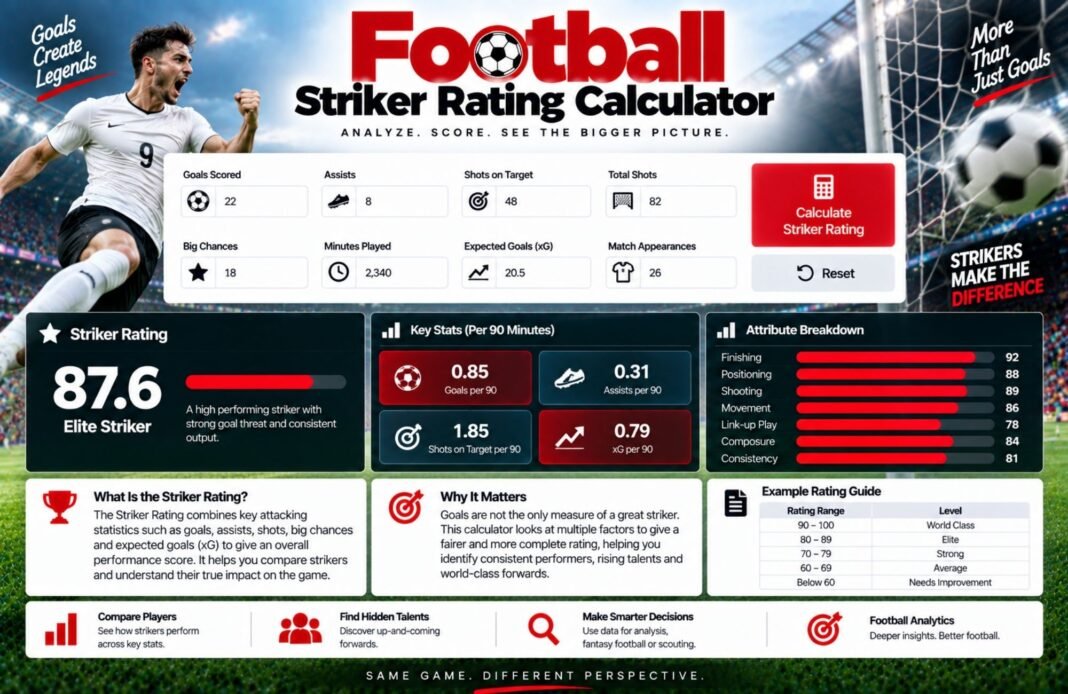
Want to see how effective a striker was in a match? Our Striker Rating Calculator uses key attacking stats such as goals, shots, finishing, and chances created to estimate an overall performance rating. It’s a quick way to compare strikers and track attacking form.
Striker Rating Calculator
Use the Striker Rating Calculator to estimate a striker’s single-match performance rating out of 10 from goals, assists, shooting, chance creation, dribbling and negative attacking events.
Football Striker Rating Calculator
Enter statistics from one match. The calculator starts at a neutral 6.0 rating and adjusts the score according to striker-relevant attacking contributions.
Calculate A Striker Match Rating
Use actual match statistics. Enter 0 for any event that did not happen in the match.
Use a consistent provider definition when comparing matches.
Striker Rating Calculator Formula
The calculator begins with a 6.0 base and adds positive striker contributions while applying limited deductions for major negative attacking events.
The final result is capped between 1.0 and 10.0 so extreme match inputs cannot create unrealistic values outside the familiar rating scale.
Striker Rating Calculator: What The Score Means
The Striker Rating Calculator is designed for a single football match. It summarizes direct attacking production, shooting threat, creation and ball-carrying into one estimated score out of 10.
The result is best used as a structured comparison aid. A striker can play well without scoring, and a striker can score while still having a quiet overall match. That is why the calculator considers several attacking dimensions instead of using goals alone.
How Goals Affect A Striker Rating
Goals receive the strongest single positive weight because scoring is a central striker responsibility. In this model, each goal adds substantially more than a shot on target, key pass or dribble.
That does not mean every goal has identical football value. A difficult winner against strong opposition and a simple finish in an already-decided match can look identical in a basic stat line. The calculator cannot see that context, so the result should still be reviewed alongside the match itself.
Multiple Goals
Two or three goals can quickly push the rating into an excellent or outstanding range. The 10.0 cap prevents a hat-trick plus several other positive actions from producing an impossible score above the normal scale.
Striker Rating Inputs Explained
Every input represents a different part of striker performance. The table below summarizes what each statistic contributes to the model.
| Input | What It Represents | Effect In The Model | Important Limitation |
|---|---|---|---|
| Goals | Direct scoring output. | Strong positive weight. | Does not reflect chance difficulty or game state. |
| Assists | Direct creation leading to goals. | Strong positive weight. | Depends on teammate finishing and provider definitions. |
| Shots On Target | Shooting threat that tests the goalkeeper. | Moderate positive weight. | Does not measure shot quality. |
| Key Passes | Chance-creating passing. | Small positive weight. | Provider definitions can vary. |
| Successful Dribbles | Ball-carrying ability that beats opponents. | Small positive weight. | Location and tactical value are not captured. |
| Big Chances Missed | High-quality scoring opportunities not converted. | Moderate deduction. | Chance definitions vary by provider. |
| Offsides | Attacking moves stopped for offside. | Small capped deduction. | Aggressive runs can create value even when some end offside. |
| Possession Lost | Times possession is recorded as lost. | Small capped deduction. | Creative and high-risk attackers naturally lose possession more often. |
Striker Rating Scale From 1 To 10
The bands below belong to this GlobeHour calculator. They are not an official rating standard used by FIFA or any league.
| Rating | Performance Band | General Interpretation |
|---|---|---|
| 9.0–10.0 | Outstanding | Match-defining attacking performance with elite output or influence. |
| 8.0–8.9 | Excellent | Major positive striker contribution with strong execution. |
| 7.0–7.9 | Strong | Clearly positive performance with meaningful attacking impact. |
| 6.0–6.9 | Solid | Generally useful performance around or above the neutral baseline. |
| 5.0–5.9 | Below Average | Limited positive impact or several negative attacking events. |
| 1.0–4.9 | Poor | Very limited influence or a match heavily affected by negative actions. |
Why Shooting Accuracy And Conversion Matter
Total shots show attacking involvement, but accuracy and conversion provide additional context. Shot accuracy measures the percentage of attempts that were on target. Shot conversion measures the percentage of all shots that became goals.
Useful Striker Formulas
Shot Accuracy % = Shots On Target ÷ Total Shots × 100
Shot Conversion % = Goals ÷ Total Shots × 100
A striker can have high shot accuracy without scoring, while another can score from a smaller number of attempts. Neither rate explains shot difficulty, so use both alongside the actual match context.
Big Chances Missed And Striker Performance
Missing a major opportunity can reduce a striker’s match impact, especially when the chance could have changed the result. The calculator therefore applies a meaningful deduction for each big chance missed.
The deduction is deliberately smaller than the positive value of scoring a goal. A striker who scores twice and misses one major chance should still receive strong credit for the two goals rather than being punished as if the positive contribution never happened.
Offsides And Possession Losses Need Context
Offsides can reflect poor timing, but they can also result from aggressive runs designed to stretch the defense. For this reason, the calculator uses only a small capped deduction rather than heavily penalizing every offside.
Possession losses are treated similarly. Creative attackers and strikers receiving the ball under pressure often lose possession more than low-risk players. The deduction is therefore intentionally limited so high-risk attacking behavior is not automatically scored as poor play.
Worked Striker Rating Examples
These examples show how different striker profiles can reach strong ratings in different ways.
| Example | Key Stats | Likely Rating Direction | Why |
|---|---|---|---|
| Clinical Finisher | 2 goals, 3 shots, 2 on target | Very High | Multiple goals carry the strongest positive weight. |
| Creative Forward | 1 goal, 1 assist, 4 key passes | High | Direct output plus chance creation creates a balanced attacking profile. |
| Threat Without Goal | 0 goals, 1 assist, 4 shots on target, 3 dribbles | Positive | Shooting threat, creation and ball carrying can compensate for no goal. |
| Wasteful Match | 0 goals, 6 shots, 2 big chances missed | Lower | Attacking involvement is offset by missed high-value chances. |
What The Striker Rating Calculator Cannot Measure
A striker’s job includes many actions that basic statistics do not fully capture. The calculator cannot see movement, pressing triggers, hold-up play, body orientation, decoy runs or how the striker occupies defenders.
Off-Ball Runs
A run can create space for a teammate without producing a shot, assist or touch.
Pressing
A striker can force a defender into a poor pass without receiving direct statistical credit.
Hold-Up Play
Receiving under pressure and bringing teammates into the attack may not appear in headline stats.
Opponent Strength
The same output can have different difficulty against different defenses.
Chance Quality
Two shots can have very different scoring probability.
Game State
A late winning goal and a goal in a decided match can have different match importance.
How To Compare Two Strikers Fairly
Use the same data provider and the same definitions for both players. Provider differences can change how key passes, big chances and possession losses are recorded.
For match-to-match comparison, compare similar playing times and competition levels where possible. A 20-minute substitute appearance should not automatically be treated as equivalent to a full 90-minute start.
For season analysis, calculate several matches consistently and look for patterns rather than treating one unusually good or poor game as the player’s true level.
Related GlobeHour Football Tools
Use these GlobeHour tools for additional player and position context.
Striker Rating Calculator Methodology & Sources
The rating weights are GlobeHour editorial assumptions built for transparent educational comparison. They do not reproduce a proprietary rating formula from FIFA, a league, a club or a commercial data provider.
Football data definitions can vary by provider, so users should keep the same source and definitions when comparing players or matches. FIFA Training Centre resources also emphasize that performance analysis includes both on-ball and off-ball actions, which is why this page explains the limits of a simple box-score rating.
Striker Rating Calculator FAQ
Quick answers about striker match ratings and the calculation.
How does the Striker Rating Calculator work?
The calculator starts at 6.0, adds weighted positive attacking events and subtracts limited negative-event deductions before capping the result between 1.0 and 10.0.
Is this an official FIFA striker rating?
No. It is a GlobeHour educational estimate and is not an official FIFA, league, club or commercial provider rating.
Why do goals have the strongest weight?
Scoring is a central striker responsibility, so goals receive the largest direct positive adjustment in this model.
Can a striker rate well without scoring?
Yes. Assists, shots on target, key passes and successful dribbles can produce a strong score even without a goal.
Why are offsides only a small deduction?
Offsides can result from aggressive attacking runs, so the calculator limits their negative effect.
Why are possession losses capped?
High-risk attacking players naturally lose the ball more often, so unlimited deductions could unfairly punish creative involvement.
Can I use this for a full season?
The form is designed for one match. For season analysis, calculate multiple matches consistently and compare the pattern.
Can I download the result?
Yes. The result includes a direct PDF download with “Generated by GlobeHour.com”.
Calculate A Striker Match Rating
Enter one match of striker statistics to calculate a transparent estimated rating out of 10.
Open Striker Rating Calculator