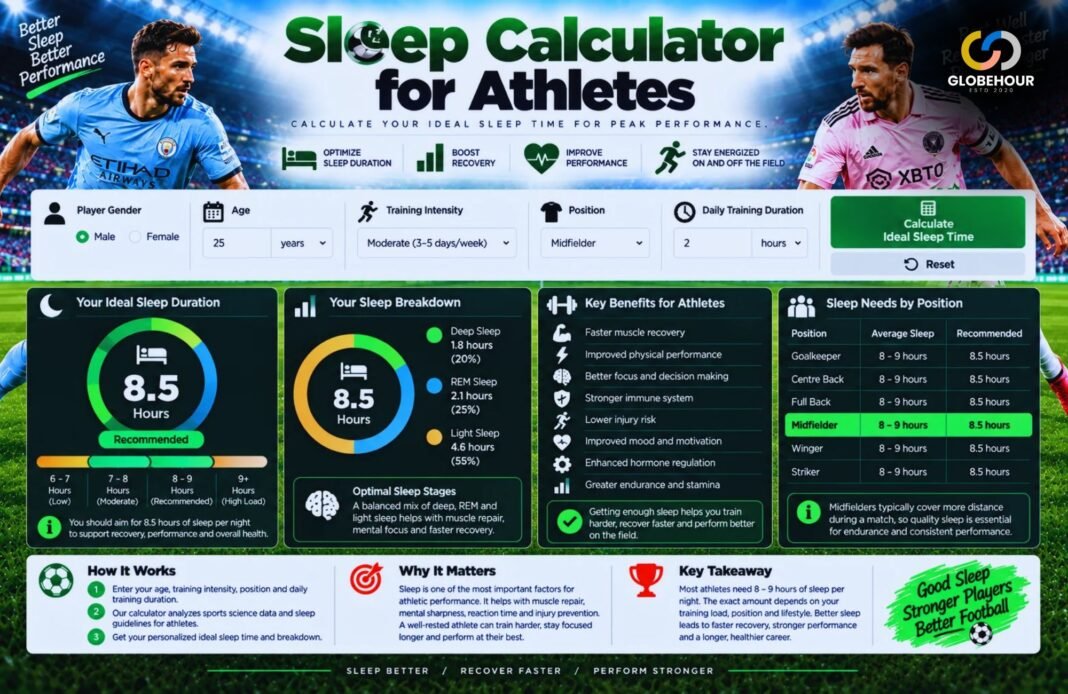
Good sleep plays a big role in athletic performance, muscle recovery, and overall fitness. The Sleep Calculator for Athletes helps you estimate how much sleep your body needs based on your age, training intensity, and activity level. Whether you’re a footballer, runner, or gym enthusiast, getting enough quality sleep can improve energy, support recovery, and help you perform at your best.
Sleep Calculator For Athletes
Find out how much sleep you need as an athlete and the best time to go to bed or wake up, based on your age, your training load and 90-minute sleep cycles.
- About You
- Your Schedule
- Sleep Plan
Tell Us About You
Your age and how hard you train shape how much sleep you need to recover.
Set Your Sleep Schedule
Tell us when you need to wake up, or when you plan to go to bed.
Please check your details: choose a time, keep minutes to fall asleep between 0 and 90, and usual sleep between 3 and 14 hours.
This is general guidance, not medical advice. If you often sleep badly, snore loudly or feel very tired during the day, speak to a doctor.
What Happens When Athletes Sleep More?
In a well-known Stanford study, basketball players aimed for 10 hours in bed each night for 5 to 7 weeks.
How The Athlete Sleep Calculator Works
Four quick steps to a better night’s sleep.
Choose Your Age Group
Teen, adult or older adult.
Pick Your Training Load
Light, moderate or heavy.
Set Your Time
Your wake-up time or your bedtime.
Get Your Sleep Plan
Bedtimes, sleep cycles and a PDF to keep.
How Much Sleep Do Athletes Need?
Sleep is when your body does much of its recovery. Muscles repair, energy stores refill and your brain sorts out the skills you practised during the day. For athletes, poor sleep can mean slower reactions, worse decisions and a harder time recovering between sessions.
Most adults are advised to get 7 to 9 hours of sleep a night, and teenagers 8 to 10 hours. But a 2021 expert consensus on sleep and the athlete, published in the British Journal of Sports Medicine, says a one-size-fits-all target is unlikely to be ideal and that each athlete’s own sleep needs should be considered. That’s why this calculator adjusts your target for both your age and how hard you train.
The GlobeHour Sleep Calculator for Athletes then turns that target into a clear bedtime or wake-up time, and shows you options based on 90-minute sleep cycles so you can choose the one that fits your day.
Sleep Targets By Age And Training Load
The hours this calculator aims for each night.
| Age Group | Light | Moderate | Heavy | General Guide |
|---|---|---|---|---|
| 14–17 (Teen) | 9 hours | 9 h 30 min | 10 hours | 8–10 hours |
| 18–64 (Adult) | 8 hours | 8 h 30 min | 9 hours | 7–9 hours |
| 65+ (Older Adult) | 7 hours | 7 h 30 min | 8 hours | 7–8 hours |
The general guide is the usual sleep advice for each age group. The light, moderate and heavy targets are GlobeHour’s assumption: they sit inside the guide and move higher as your training gets harder, because harder training needs more recovery.
How Your Bedtime Is Calculated
Example: an adult with moderate training who needs to wake up at 7:00 AM and takes 15 minutes to fall asleep.
| Step | Formula | Example |
|---|---|---|
| Sleep Target | From the age and training table | 8 h 30 min |
| Bedtime | Wake-up time − sleep target − minutes to fall asleep | 7:00 AM − 8 h 30 min − 15 min = 10:15 PM |
| Sleep Cycles | Sleep target ÷ 90 minutes | 510 ÷ 90 = 5.7 cycles |
| Best Cycle Match | Whole number of cycles closest to your target | 6 cycles (9 hours) → bed at 9:45 PM |
| Weekly Gap | (Target − usual sleep) × 7 | (8.5 − 7) × 7 = 10 h 30 min |
If you choose bedtime instead, the calculator works forwards: bedtime + minutes to fall asleep + sleep target = your wake-up time.
Why 90-Minute Sleep Cycles Matter
Through the night you move through repeating cycles of light sleep, deep sleep and dream (REM) sleep. A cycle is often said to last around 90 minutes, although the real length varies from person to person and through the night.
- Waking at the end of a cycle can help you feel less groggy than waking from deep sleep.
- Total sleep matters most. Use the cycle options as a guide, not a reason to cut your sleep short.
- Your own body is the best guide. If you wake up before your alarm feeling fresh, you’re probably getting enough.
Sleep Tips For Athletes
- Go to bed and wake up at the same time every day.
- Keep your bedroom cool, dark and quiet.
- Put phones and screens away 30 to 60 minutes before bed.
- Avoid caffeine in the late afternoon and evening.
- Don’t worry about one bad night before a match. Good sleep across the whole week matters more.
- After late games, give yourself time to wind down before bed.
- When travelling, try to match your sleep to the local time quickly.
- If you nap, keep it short and early in the afternoon.
Sleep Calculator For Athletes FAQ
How Many Hours Of Sleep Does An Athlete Need?
Most adults are advised to get 7 to 9 hours and teenagers 8 to 10 hours. Athletes who train hard often benefit from the top of that range. This calculator suggests 8 to 9 hours for adult athletes, depending on training load.
Is The Sleep Calculator For Athletes Free?
Yes. It is completely free, needs no sign-up and works on phones, tablets and computers. You can also download your sleep plan as a PDF.
Does More Sleep Improve Sports Performance?
In a Stanford study, basketball players who aimed for 10 hours in bed for several weeks sprinted faster (16.2 to 15.5 seconds) and shot about 9% better on free throws and 3-pointers.
What Time Should I Go To Bed To Wake Up At 7 AM?
An adult with moderate training who takes 15 minutes to fall asleep should be in bed by about 10:15 PM to get 8 hours 30 minutes of sleep.
How Long Is A Sleep Cycle?
A sleep cycle is often said to last about 90 minutes, but it varies between people and through the night.
Should Athletes Sleep More Before A Match?
Good sleep through the whole week matters more than one night. Many athletes sleep badly the night before a big game, so it helps to bank good sleep in the days before.
What Is Sleep Debt?
Sleep debt is the gap between the sleep you need and the sleep you get. Add your usual sleep in the calculator to see your nightly and weekly gap.
Can Teenage Athletes Use This Calculator?
Yes. Choose the 14–17 age group. Teenagers need more sleep than adults, so the targets are higher.
Is My Information Saved?
Your choices are saved only in your own browser. Nothing is sent to GlobeHour.
Related GlobeHour Tools
Ready To Sleep Like An Athlete?
Choose your age and training load, set your time, and get your bedtime and sleep plan in seconds.
Open The Sleep Calculator