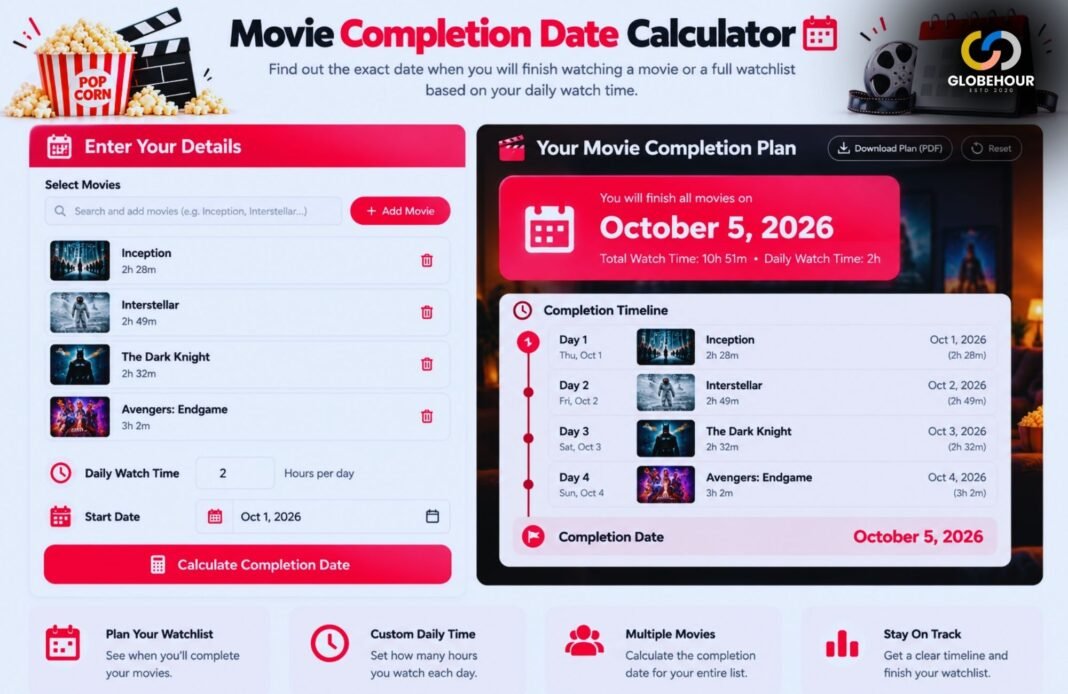
Want to know when you will finish a movie or a long watchlist? The Movie Completion Date Calculator works it out based on your start date and how much time you plan to watch each day. It makes it easy to see your expected finish date before you begin.
Movie Completion Date Calculator
Estimate the date you will finish a movie list, collection or personal watch challenge. The Movie Completion Date Calculator combines your remaining movies, average runtime, daily viewing time and weekly watch schedule to build a realistic finish-date estimate.
Estimate Your Movie Completion Date
Enter your remaining movies and the amount of time you can realistically watch on each viewing day.
Your Movie-Watching Plan
Use your own start date, movie count, average runtime and weekly schedule.
How The Movie Completion Date Calculator Works
The estimate converts your remaining watchlist into total viewing minutes and places those minutes onto your allowed calendar days.
The result is a planning estimate. Actual completion can move earlier or later if movie runtimes, skipped days or your daily viewing time change.
What Is A Movie Completion Date Calculator?
A Movie Completion Date Calculator estimates the calendar date on which you can finish a movie watchlist. Instead of looking only at the number of titles, it translates the list into total viewing time and then compares that time with the amount you can watch on your normal viewing days.
This is useful for a personal film challenge, a director or actor marathon, a franchise rewatch, an awards-season list, a long backlog of saved movies or any goal where you want to know, “If I keep this pace, when will I actually be done?”
The calculator is designed around a simple idea: a list of 30 movies does not automatically mean 30 days. Some people watch one film every evening, others watch only on weekends, and some split long movies across several sessions. Runtime and schedule matter as much as title count.
Turn A Watchlist Into A Real Calendar Plan
Use your available viewing time and regular watch days to replace a vague movie goal with a practical estimated completion date.
How To Use The Movie Completion Date Calculator
Enter Your Watchlist
Add the total number of movies and subtract any titles you have already completed.
Add Average Runtime
Use a realistic average movie length in minutes for the titles you plan to watch.
Set Your Weekly Schedule
Choose daily, weekdays, weekends or your own custom viewing days.
Calculate Your Finish Date
See your projected date, watch days, total hours and calendar span.
For the strongest estimate, use a daily viewing-time value you can maintain. If two hours is realistic on most watch days, enter 120 minutes. If you normally watch for only 90 minutes, use 90 instead of assuming you will always finish a two-hour movie in one sitting.
If your list includes unusually long or short titles, calculate a rough average first. You can use the Movie Runtime Calculator to convert and compare runtimes before entering an average here.
Movie Completion Date Formula Explained
Step One: Remaining Movies
Remaining Movies = Total Movies − Movies Already Completed.
Step Two: Planned Minutes
Planned Minutes = Remaining Movies × (Average Runtime + Extra Time Per Movie).
Step Three: Viewing Days
Viewing Days = Planned Minutes ÷ Minutes Available Per Watch Day, rounded up to the next whole session.
Step Four: Calendar Placement
The required viewing sessions are assigned only to the weekdays included in your selected schedule.
The final step is what separates a movie completion date from a basic runtime calculation. Ten watch sessions take ten calendar days if you watch every day, but the same ten sessions can stretch across several weeks if you watch only on Saturdays and Sundays.
Planning rule: the calculator treats your daily viewing-time setting as the amount of progress you can make on each allowed watch day. A movie may therefore continue across multiple sessions if your daily time is shorter than the movie’s runtime.
Movie Completion Date Examples
| Watchlist | Average Runtime | Viewing Plan | Estimated Watch Sessions | What Changes The Finish Date? |
|---|---|---|---|---|
| 10 Movies | 120 Minutes | 120 Minutes Every Day | 10 Days | Skipped days or longer-than-average movies. |
| 20 Movies | 105 Minutes | 120 Minutes On Weekdays | 18 Watch Days | Weekends are excluded from the calendar count. |
| 12 Movies | 150 Minutes | 180 Minutes On Weekends | 10 Watch Days | Only Saturday and Sunday count. |
| 50 Movies | 110 Minutes | 90 Minutes Daily | 62 Watch Days | Some movies will span more than one viewing session. |
| 8 Movies | 130 Minutes | 150 Minutes Three Custom Days Weekly | 7 Watch Days | The exact weekday pattern controls the calendar span. |
These examples show why the number of movies alone is not enough. A smaller list of long movies watched only on weekends can take longer to finish than a larger list of short movies watched every day.
Choose A Realistic Average Movie Runtime
Average runtime is one of the most important inputs in the Movie Completion Date Calculator. If your planned titles are mostly around 90 minutes, entering 120 minutes will make the finish date unnecessarily late. If your list is dominated by long epics, entering 90 minutes can make the estimate too optimistic.
A practical method is to sample several movies from your list, add their runtimes and divide by the number of sampled titles. If the list is small, use every movie. If it is very large, a representative sample can still provide a useful planning average.
When To Use A Higher Runtime Estimate
Use a higher average if your list includes director’s cuts, historical epics, long franchise finales or older films with overtures and extended credits that you intend to watch in full.
When To Use A Lower Runtime Estimate
Use a lower average for lists built around animation, short features, classic comedies or other categories where many titles stay well below two hours.
Runtime note: different cuts or releases of the same movie can have different runtimes. If exact timing matters, verify the version you plan to watch on the service, disc or database you use.
Daily Viewing Time Vs Movies Per Day
This calculator uses viewing minutes rather than a fixed “movies per day” number because viewing time is more flexible. A person with two hours available may finish one 95-minute movie and still have time left, while a 180-minute movie may require more than one session.
Using minutes also helps when you do not insist on finishing a movie in one sitting. If you have only 60 minutes available each evening, the calculator can still estimate progress through longer titles instead of forcing every movie into a single day.
Short Daily Sessions
Useful when you watch a portion of a film after work or before bed and continue later.
One-Movie Evenings
Set your daily viewing time close to your average runtime if you normally watch one full movie per session.
Long Marathon Days
Enter several hours when you regularly watch multiple movies on the same scheduled day.
How Weekly Watch Schedules Affect Your Completion Date
Watching Movies Every Day
An everyday schedule produces the shortest calendar span for the same daily viewing time because every date can carry a viewing session. This works well for compact challenges and for viewers who watch a little each evening.
Watching On Weekdays
A Monday-to-Friday schedule automatically skips Saturdays and Sundays. The same number of viewing sessions therefore occupies more calendar days than an everyday plan.
Watching On Weekends
Weekend-only plans often create the biggest gap between watch days and calendar days. They can still work well for longer sessions, especially if Saturday and Sunday provide more uninterrupted time.
Using Custom Watch Days
Choose custom days when your routine is specific, such as Tuesday, Thursday and Saturday. The calculator follows those selected weekdays on the calendar instead of converting them into a generic “three days per week” estimate.
Consistency Matters More Than An Aggressive Goal
A slower schedule you can repeat is usually more useful for planning than an ambitious daily target that you rarely follow.
Use Extra Time Per Movie For More Realistic Planning
The optional extra-time field can account for activity that happens around the movie itself. You might spend time choosing a title, preparing snacks, taking an intermission, discussing the film afterward or watching the full credits.
For example, adding 10 minutes to each movie in a 30-film list creates 300 additional minutes of planned time. That is five extra hours across the challenge. The effect may be small on a short list but noticeable on a large collection.
- Add a few minutes if you normally watch trailers or bonus introductions.
- Add break time for very long movies or family viewing sessions.
- Use zero when you only want the movie runtime itself.
- Keep the same assumption across the list for a consistent estimate.
- Increase the buffer for discussion-heavy film clubs or group nights.
- Recalculate if your viewing routine changes significantly.
Planning A Movie Marathon Or Franchise Rewatch
A Movie Completion Date Calculator is useful when a franchise has grown too large for a single weekend. Instead of trying to watch every title at once, you can spread the collection across several evenings and see when the full series should be complete.
For a concentrated event, the Movie Marathon Calculator can help with the total time required for several films. If you already know the exact movie you will watch tonight and only need the finishing clock time, use the Movie End Time Calculator.
For a broader evening plan that includes choosing a start time and organizing the session, the Movie Night Planner can complement this longer-term completion estimate.
Optional Target Finish Date: Are You On Pace?
If you have a deadline, add a target finish date. The calculator compares your current plan with that goal and estimates how many minutes you would need on each available watch day to finish by the target.
This can be helpful before a sequel release, a film festival, an awards event, a class discussion or a personal challenge deadline. If the current plan finishes after your target, you can adjust one of three main variables: increase viewing time per session, add more watch days or reduce the number of remaining movies.
If You Finish Early
Your current schedule has calendar buffer. You may be able to miss some sessions without losing the target date.
If You Finish Late
Use the required-minutes figure to understand how much additional viewing time would be needed on each scheduled day.
Movie Completion Date Calculator Tips
- Use your real remaining movie count rather than the original size of the list.
- Estimate average runtime from the movies you actually intend to watch.
- Enter viewing time you can sustain on a normal day.
- Use custom weekdays when your schedule is predictable but not daily.
- Add a small time buffer if breaks or setup are part of every session.
- Recalculate after several movies if the list’s average runtime changes.
- Use a target date only when you have a genuine deadline or goal.
- Check exact movie runtimes separately when the final date must be precise.
For title-specific information, services such as IMDb can help you check listed runtimes. If age classification matters for your watchlist, consult the relevant official classification source; in the United States, FilmRatings.com provides information about the MPA film rating system.
Movie Completion Date Calculator Vs Related Tools
| Tool | Main Question | Best Use |
|---|---|---|
| Movie Completion Date Calculator | When will I finish my entire movie list? | Long-term watchlists, challenges and collections. |
| Movie End Time Calculator | What clock time will one movie finish? | Planning a single movie tonight. |
| Movie Runtime Calculator | How long is this runtime in hours and minutes? | Converting or understanding movie duration. |
| Movie Marathon Calculator | How long will several movies take together? | Back-to-back viewing sessions and franchise marathons. |
Related Movie Tools
Movie Completion Date Calculator FAQ
What Is A Movie Completion Date Calculator?
It is a planning tool that estimates when you will finish a movie watchlist by combining your remaining movie count, average runtime, viewing time per watch day and weekly schedule.
Does The Calculator Assume One Movie Per Day?
No. It works with viewing minutes. A short movie may use less than one session, while a long movie can extend across more than one watch day.
Can I Use The Calculator For A Franchise Marathon?
Yes. Enter the number of remaining franchise movies, their average runtime and the days on which you plan to watch.
What If I Only Watch Movies On Weekends?
Choose the weekend schedule. The calculator will count Saturday and Sunday as viewing days and skip Monday through Friday.
Can I Choose Specific Days Of The Week?
Yes. Select the custom schedule option and choose the exact weekdays you normally use for movie watching.
What Does Extra Time Per Movie Mean?
It is optional time added to every remaining title for breaks, setup, credits, discussion or any other repeated activity around each movie.
How Accurate Is The Completion Date?
The calculation is exact for the inputs you provide, but real-life completion can change if you skip scheduled days, watch more or less time than planned, or if actual runtimes differ from your average.
Can I Add A Target Finish Date?
Yes. The optional target date compares your projected completion with your goal and estimates the viewing minutes needed per available session to meet that target.
Does This Calculator Check Streaming Availability?
No. Streaming catalogs vary by service and location. The calculator focuses only on time and schedule planning.
Do I Need An Account Or API?
No. The Movie Completion Date Calculator runs directly in your browser with JavaScript and does not require an account or external API.
Find The Date You Will Finish Your Movie List
Add your watchlist, runtime and weekly schedule to turn your movie goal into a clear calendar estimate.
Calculate My Completion DateExplore more movie and entertainment tools on GlobeHour.