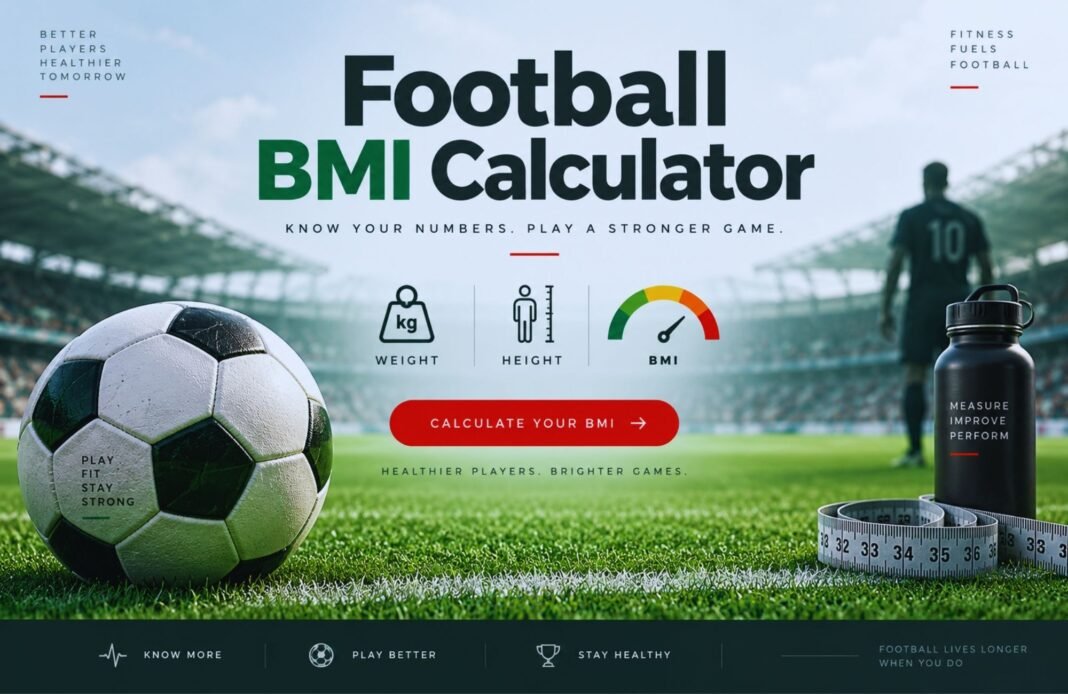
Use our Football BMI Calculator to quickly check your BMI using your height and weight. It gives you an instant result and helps you understand what the number means for football players, while keeping in mind that muscle mass and body composition can affect BMI.
Football BMI Calculator
Work out a player’s body mass index in metric or imperial units, see the healthy weight range for their height, check waist-to-height ratio and understand what BMI really means for footballers.
- Player Profile
- Measurements
- Your BMI
Tell Us About The Player
Age decides whether adult BMI categories apply. Sex is only used for the body fat estimate.
Enter an age between 2 and 100.
Enter Height And Weight
Measure without shoes and in light clothing for the most accurate result. Waist is optional.
Please enter a realistic height and weight.
BMI is a screening measure, not a diagnosis. It does not separate muscle from fat. For advice about weight or health, speak to a doctor, registered dietitian or qualified sports professional.
Adult BMI Categories On One Scale
Where common BMI values sit, from underweight to obesity.
How The Football BMI Calculator Works
Four quick steps from measurements to a clear, football-focused result.
Add Your Profile
Choose units, enter age and sex, and pick your position if you like.
Enter Measurements
Add height and weight, plus your waist for a better picture.
Get Your BMI
See your BMI, its category and the healthy weight range for your height.
Read The Context
Understand what the number means for a footballer and what to check next.
What Is A Football BMI Calculator?
Body mass index (BMI) compares your weight with your height to give one number. Doctors and health services use it as a quick screening tool because it is easy to measure and works reasonably well for most adults.
Footballers are not most adults, though. Training builds muscle, and muscle is heavier than fat for the same volume. A strong, fit centre back can have a BMI that looks “overweight” while carrying very little fat. The GlobeHour Football BMI Calculator gives you the standard BMI result and then adds the context a player needs: the healthy weight range for your height, your waist-to-height ratio, a rough body fat estimate and what your result means in football terms.
How BMI Is Calculated
Imperial: BMI = 703 × weight (lb) ÷ height (in)²
Metric Example
A player who is 180 cm tall and weighs 75 kg: 1.80 × 1.80 = 3.24, and 75 ÷ 3.24 = 23.1. That sits in the healthy weight range.
Imperial Example
A player who is 5 ft 10 in (70 inches) and weighs 165 lb: 70 × 70 = 4,900, and 703 × 165 ÷ 4,900 = 23.7.
Healthy Weight Range For Your Height
The calculator also turns the healthy BMI range of 18.5 to 24.9 back into kilograms or pounds for your height. For the 180 cm player above, that is about 59.9 kg to 80.7 kg.
Adult BMI Categories
For adults aged 20 and older.
| BMI | Category | What It Can Mean For A Footballer |
|---|---|---|
| Below 18.5 | Underweight | May lack the energy and strength to train and recover well. |
| 18.5 To 24.9 | Healthy Weight | Where most players sit. Focus on fitness, strength and recovery. |
| 25 To 29.9 | Overweight | Common for muscular players. Check waist and body fat before worrying. |
| 30 To 34.9 | Obesity Class 1 | Worth discussing with a health professional, even for strong players. |
| 35 To 39.9 | Obesity Class 2 | Speak to a doctor before increasing training load. |
| 40 Or More | Obesity Class 3 | Get medical advice before starting a new training programme. |
Why BMI Can Mislead Footballers
BMI only uses height and weight. It cannot tell whether the weight comes from muscle, bone or fat, and it says nothing about where fat is stored. For athletes this matters a lot.
- Muscle counts as weight. Strong defenders, goalkeepers and target strikers can score 25 or more with low body fat.
- Lean players can look underweight. Small, light wingers may sit near 18.5 and still be fit and healthy.
- Teenagers are still growing. Adult categories do not apply under 20, because body shape changes with age.
- BMI ignores performance. Speed, stamina and strength tell you far more about match fitness.
Waist-To-Height Ratio And Body Fat
Waist-To-Height Ratio
Divide your waist by your height, using the same units. Because it looks at the waist, it is less fooled by muscle than BMI. A common guide is to keep your waist to less than half your height.
| Waist-To-Height Ratio | Guide |
|---|---|
| Below 0.40 | Very low. Check you are eating enough to fuel training. |
| 0.40 To 0.49 | Healthy range. |
| 0.50 To 0.59 | Increased health risk. |
| 0.60 Or More | High health risk. Speak to a health professional. |
Body Fat Estimate
For adults, the calculator gives a rough body fat estimate using the Deurenberg formula, which uses BMI, age and sex. It tends to overestimate body fat in muscular athletes, so treat it as a guide only. Skinfold tests or body scans by a professional are far more accurate.
BMI For Players Under 20
Children and teenagers grow at different rates, so their BMI is compared with other young people of the same age and sex using BMI-for-age percentile charts. The adult categories in this calculator are not used for anyone under 20.
If you enter an age under 20, the calculator still shows the BMI number but asks you to check it on a BMI-for-age chart or with a doctor or school nurse. For young players, enjoying football, eating well and sleeping enough matter far more than any single number.
Body Size And Football Positions
Players of every shape and size succeed in football. These are general patterns, not rules.
Goalkeepers
Height And ReachGoalkeepers are often among the tallest players in a squad. Extra height and muscle can push BMI higher, which is normal when it comes from strength and power.
Defenders
Strength For DuelsCentre backs tend to be tall and strong for aerial and physical duels. Full-backs are usually lighter and built for repeated sprints up and down the flank.
Midfielders
Built For EnduranceMidfielders cover the most distance in a match, so many have a lean, endurance-focused build with BMI comfortably in the healthy range.
Forwards
Power Or SpeedForwards vary the most. Target strikers can be tall and heavy, while quick wingers and second strikers are often smaller and lighter.
Healthy Habits For Footballers
- Eat enough to fuel training, with plenty of carbohydrates on heavy days.
- Include protein in each meal to help muscles recover.
- Drink water before, during and after training and matches.
- Aim for regular, good-quality sleep every night.
- Add strength training to protect against injury.
- Track performance tests, not just your weight.
- Weigh yourself at the same time of day for fair comparisons.
- Speak to a professional before changing your weight on purpose.
Football BMI Calculator FAQ
How Do I Calculate My BMI?
Divide your weight in kilograms by your height in metres squared. In imperial units, multiply your weight in pounds by 703 and divide by your height in inches squared. The calculator does this for you.
Is The Football BMI Calculator Free?
Yes. It is completely free, needs no sign-up and works on phones, tablets and computers.
What Is A Healthy BMI For Adults?
For adults aged 20 and older, a BMI from 18.5 to less than 25 is in the healthy weight range.
Is BMI Accurate For Football Players?
Only partly. BMI cannot separate muscle from fat, so muscular players can be labelled overweight. Waist-to-height ratio and body fat testing give a better picture.
Why Does My BMI Say Overweight When I Am Fit?
If you carry a lot of muscle, your weight can be high for your height even with low body fat. Check your waist-to-height ratio. If it is below 0.5, your BMI is likely high because of muscle.
Can Children Use This Calculator?
Yes, it shows the BMI number, but adult categories do not apply under 20. Young players should compare their BMI on a BMI-for-age chart or ask a doctor.
What Is Waist-To-Height Ratio?
It is your waist divided by your height. Keeping it below 0.5, meaning your waist is less than half your height, is a widely used healthy target.
How Accurate Is The Body Fat Estimate?
It is a rough estimate from BMI, age and sex, and it often overestimates body fat in athletes. Use skinfold tests or body scans for accurate numbers.
What BMI Should A Footballer Have?
There is no single ideal BMI for footballers. Body size varies a lot by position and playing style, so focus on fitness, strength, waist size and how you feel and perform.
Is My Information Saved?
Your measurements are saved only in your own browser so you can update them later. Nothing is sent to GlobeHour.
Related GlobeHour Football Tools
Ready To Check Your BMI?
Height, weight and an optional waist measurement are all you need. It takes less than a minute.
Open The BMI Calculator