Recovery is just as important as training when it comes to football performance. The Football Recovery Time Calculator helps players estimate how much rest they may need after a match or training session based on workout intensity and physical effort. Whether you’re a beginner or a professional player, getting enough recovery time can reduce fatigue, support muscle repair, and help you prepare for your next game.
Football Recovery Time Calculator
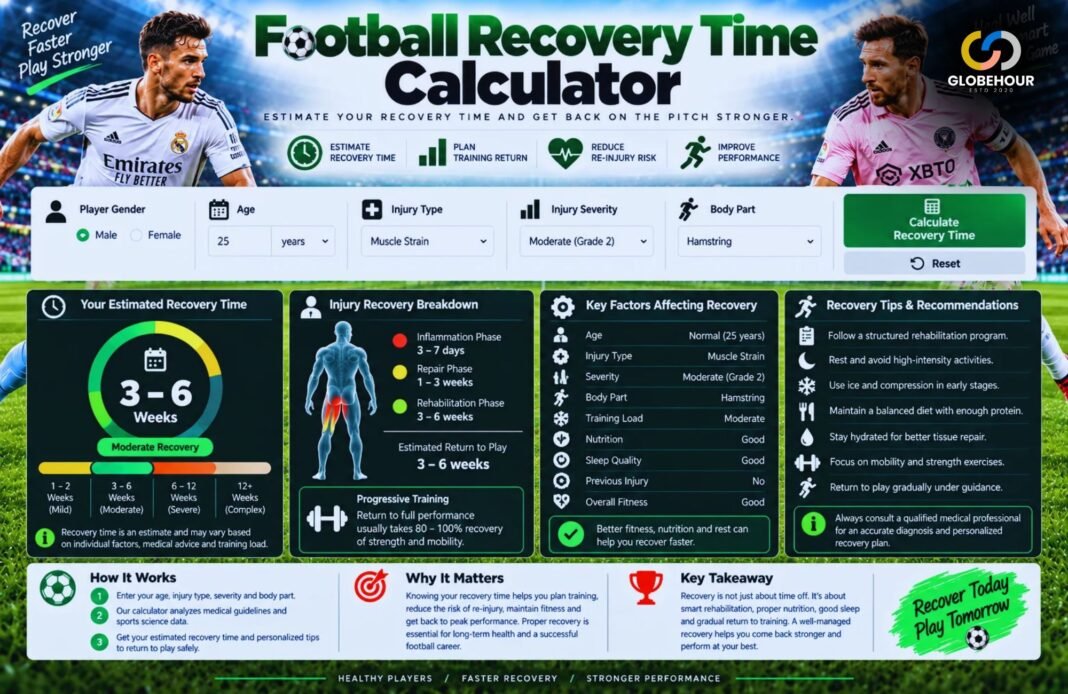
Find out how long you need to recover after a match or training session. Based on minutes played, effort, position, sleep, soreness and age, it shows when you can train lightly, train normally and play again at full intensity.
- Session
- Load And Body
- Recovery Time
What Did You Just Do?
Pick your position and the type of session you’re recovering from.
How Hard Was It?
Minutes and effort are required. Sleep, soreness and age make the estimate more accurate.
About You (optional, but more accurate)
When Did It End? (to show the exact day and time you’ll be ready)
Please check your details.
This is an estimate based on football research and typical training loads. Everyone recovers differently. It is not medical advice. If you have pain that feels like an injury, see a physio or doctor.
How Long Does Football Recovery Take?
A hard match can leave your legs below their best for up to three days.
How The Recovery Time Calculator Works
Four quick steps to your recovery timeline.
Pick Your Session
Choose your position and match or training type.
Rate The Load
Enter minutes, effort, sleep, soreness and age.
See Your Timeline
Know when to train lightly, normally and at full intensity.
Download Your Plan
Save it as a PDF to share with your coach.
Why Recovery Time Matters In Football
Football is full of sprints, jumps, tackles and sharp changes of direction. These actions cause small amounts of muscle damage and use up your energy stores. Until your body repairs that damage, your speed, power and strength stay a little lower than normal, even if you feel fine.
Going back to hard training too early means you train below your best and may raise your risk of injury. Resting too long wastes training time. Knowing roughly how long you need helps you and your coach plan the week.
This calculator starts from a typical recovery time for your type of session, then adjusts it for how long and how hard you worked, your position, how well you slept, how sore you are and your age.
How Your Recovery Time Is Calculated
Example: a 24-year-old midfielder who played a full 90-minute match at effort 8, slept 7 hours and has soreness of 5.
| Step | How It Works | Example |
|---|---|---|
| Base Time | Match 66 h, hard training 36 h, normal training 24 h, light session 12 h | Match: 66 h |
| Session Load | Minutes × effort (RPE), compared with a typical session | 90 × 8 = 720 AU, typical (no change) |
| Position | Goalkeeper −15%, midfielder +5%, others no change | +5% |
| Sleep | Under 6 h +15%, 6–7 h +8%, 7–8 h no change, 8 h or more −5% | 7 h: no change |
| Soreness | +4% for each point above 3 out of 10 | 5/10: +8% |
| Age | 30–34 +8%, 35 or older +15% | 24: no change |
| Full Recovery | Base × all factors (6 to 96 hours) | 66 × 1.05 × 1.08 ≈ 75 h |
So this player needs about 75 hours, or 3.1 days, to fully recover. They can start light training after about 30 hours and normal training after about 53 hours. The load effect uses the square root of your load compared with a typical session, kept between −40% and +40%.
What To Do After A Football Match
Straight After
Refuel and rehydrateStart recovering as soon as the final whistle goes. Your muscles are ready to soak up fuel and fluid.
- Eat: carbohydrate plus 20 to 25 g of protein
- Drink: water or a sports drink, more on hot days
Active Recovery
Move gentlyLight movement helps you feel less stiff. Keep everything easy and short.
- Do: 20 to 30 minutes of cycling, swimming or walking
- Avoid: sprints, jumps and heavy gym work
Light Training
Build back upMost players can return to light technical work, but legs may still feel heavy.
- Do: rondos, passing drills, easy running
- Check: soreness should be getting better
Back To Full
Full intensityAfter a hard match, most players are close to full recovery by about 72 hours.
- Do: normal training, sprints and small-sided games
- Watch: any pain that isn’t going away
Does Recovery Time Change By Position?
- Goalkeepers run much less, so they usually recover faster, though diving still loads the hips and shoulders.
- Defenders make lots of jumps, tackles and headers, which add to muscle soreness.
- Midfielders usually cover the most distance, so they often need the longest to recover.
- Forwards make many short sprints and sharp turns. The same study linked short sprints to more soreness two to three days later.
What you actually did matters more than your position. A forward who pressed for 90 minutes may need longer than a midfielder who played 30 minutes, which is why minutes and effort count the most.
Tips To Recover Faster After Football
- Sleep 8 to 9 hours, especially the night after a match.
- Eat carbs and protein within an hour of finishing.
- Drink regularly until your urine is pale.
- Do light cycling, swimming or walking the next day.
- Use mobility and gentle stretching to ease stiffness.
- Try massage or cold-water immersion if you like them.
- Avoid alcohol, which slows muscle repair and rehydration.
- Track your soreness each morning to spot trends.
Soreness Or Injury? Know The Difference
Normal muscle soreness is a dull, general ache in the muscles you used. It usually peaks one to two days after the session and then fades. Moving gently often makes it feel a little better.
An injury feels different. Sharp or stabbing pain in one spot, pain in a joint, swelling, bruising, pain that gets worse when you move, or having to limp are all warning signs. Don’t train through these.
Football Recovery Time Calculator FAQ
How Long Does It Take To Recover After A Football Match?
Most players need about 48 to 72 hours to fully recover after a full, hard match. Research found that sprint speed, jump height and hamstring strength can stay lower for up to 72 hours.
Is The Recovery Time Calculator Free?
Yes. It is completely free, needs no sign-up and works on phones, tablets and computers.
What Is RPE?
RPE means rating of perceived exertion. Rate how hard the whole session felt from 1 (very easy) to 10 (maximal). Minutes multiplied by RPE gives your session load.
Can I Train The Day After A Match?
Yes, but keep it light. Easy cycling, swimming, walking and mobility work help you recover. Save sprints and hard drills until you are fully recovered.
Why Do Midfielders Need Longer To Recover?
Midfielders usually cover the most distance in a match, so their total running load is often the highest. Goalkeepers run much less and usually recover faster.
Does Sleep Really Affect Recovery?
Yes. Sleep is when most muscle repair happens. Sleeping less than 7 hours can slow recovery, while 8 to 9 hours helps you bounce back.
How Do I Know If It’s Soreness Or An Injury?
Normal soreness is a dull, general ache that eases over 2 to 3 days. Sharp pain in one spot, swelling, bruising or limping may be an injury, so see a physio or doctor.
Can I Download My Recovery Plan As A PDF?
Yes. After you calculate, tap Download PDF to save a one-page plan with your recovery timeline, ready to print or share with your coach.
Is My Information Saved?
Your details are saved only in your own browser. Nothing is sent to GlobeHour.
Related GlobeHour Football Tools
Ready To Plan Your Recovery?
Enter your session and get your recovery timeline in seconds.
Open The Recovery Calculator