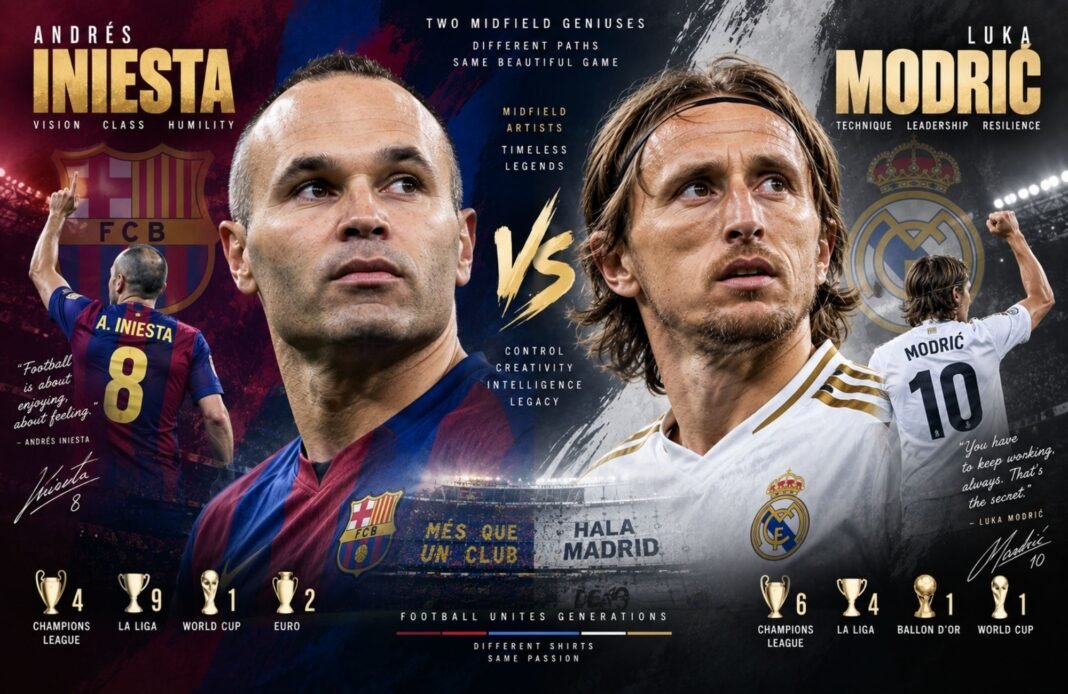
Andrés Iniesta vs Luka Modrić: Two midfielders. Two different worlds. One Spanish genius shaped by Barcelona’s tiki-taka machine. One Croatian warrior who carried a nation on his back. This is the Iniesta vs Modrić debate — and it has no easy answer.
Andrés Iniesta vs Luka Modrić
Andrés Iniesta and Luka Modrić belong to the same elite class of midfielders, but their games were built differently.
Iniesta came through Barcelona’s La Masia academy and became a master of tight spaces. His balance, close control and ability to escape pressure made him one of the most difficult midfielders to contain.
Modrić developed into a more complete all-round midfielder. He could dictate possession, carry the ball through midfield, defend, press and still create in advanced areas.
The Artist in Tight Spaces
Iniesta was at his best when space disappeared. He could receive under pressure, change direction in one movement and create an opening where none appeared to exist.
His influence was rarely about volume. It was about timing, touch and choosing the right moment.
The Complete Midfielder
Modrić offered greater range. He could play deep, move box to box, carry the ball over distance and control matches from different areas.
That flexibility helped him remain effective under different managers and tactical systems for more than a decade.
All-Time Career Numbers
Iniesta finished with 1,016 career appearances, 107 goals and 191 assists. Modrić has now moved beyond the older totals, with his club and international career continuing into 2026.
Using the latest figures, Modrić has 936 club appearances and 202 senior caps for Croatia. That takes him to 1,138 senior club and international matches.
Iniesta remains ahead in assists, while Modrić has the stronger scoring total and a longer overall career.
| Career Stat | Iniesta | Modrić |
|---|---|---|
| Total Matches | 1,016 | 1,138 |
| Goals | 107 | 128 |
| Assists | 191 | 173 |
| Free-Kick Goals | 2 | 2 |
| Penalty Goals | 18 | 23 |
Iniesta vs Modrić at a Glance
Two midfield careers defined by creativity, control and success at the highest level.
Senior Matches
Club Assists
Major Milestones
Club Career
Iniesta played 885 club matches, scoring 93 goals and providing 161 assists. Most of that career was spent with Barcelona, before later spells in Japan and the UAE.
Modrić has now reached 936 club appearances, with 99 goals and 144 assists. His path included Dinamo Zagreb, Tottenham Hotspur, Real Madrid and AC Milan.
Iniesta remains ahead in assists. Modrić has played more club football and has continued competing at the top level for longer.
| Club Stat | Iniesta | Modrić |
|---|---|---|
| Matches | 885 | 936 |
| Goals | 93 | 99 |
| Assists | 161 | 144 |
Champions League
The Champions League comparison is one of the most interesting parts of their careers.
Iniesta played 130 matches, scored 11 goals and provided 29 assists. Modrić has now reached 142 appearances, with nine goals and 20 assists.
Iniesta has the stronger attacking numbers. Modrić has the larger medal collection, with six Champions League titles compared with four for Iniesta.
| Champions League Stat | Iniesta | Modrić |
|---|---|---|
| Matches | 130 | 142 |
| Goals | 11 | 9 |
| Assists | 29 | 20 |
| Titles | 4 | 6 |
Competition history is available through UEFA Champions League.
International Career
Iniesta made 131 senior appearances for Spain, scoring 14 goals and providing 30 assists. His international career coincided with Spain’s greatest era.
Modrić has now reached 202 appearances for Croatia, with 29 goals and 29 assists.
Iniesta has the stronger trophy record. He won the World Cup and two European Championships. Modrić never won a major senior international trophy, but he led Croatia to the 2018 World Cup final and a third-place finish in 2022.
| International Stat | Iniesta | Modrić |
|---|---|---|
| Matches | 131 | 202 |
| Goals | 14 | 29 |
| Assists | 30 | 29 |
| Major Titles | World Cup + 2 EUROs | 0 |
World Cup
Iniesta’s place in World Cup history is secure because of one moment. He scored the winning goal against the Netherlands in the 2010 final.
Across 14 World Cup matches, he scored twice and provided three assists.
Modrić played 19 World Cup matches, scoring twice and providing one assist. His defining tournament came in 2018, when Croatia reached the final and he won the Golden Ball.
| World Cup Stat | Iniesta | Modrić |
|---|---|---|
| Matches | 14 | 19 |
| Goals | 2 | 2 |
| Assists | 3 | 1 |
| Titles | 1 | 0 |
Tournament history can be explored through FIFA.
UEFA European Championship
Iniesta played 16 European Championship matches and provided five assists. He did not score, but he helped Spain win both Euro 2008 and Euro 2012.
Modrić also played 16 Euro matches, scoring four goals and providing one assist.
The individual scoring numbers favour Modrić. The trophy record belongs to Iniesta.
| Euro Stat | Iniesta | Modrić |
|---|---|---|
| Matches | 16 | 16 |
| Goals | 0 | 4 |
| Assists | 5 | 1 |
| Titles | 2 | 0 |
La Liga Career
Iniesta played 442 La Liga matches for Barcelona, scoring 35 goals and providing 84 assists.
Modrić completed his Real Madrid league career with 394 appearances, 30 goals and 66 assists.
Iniesta also won nine La Liga titles, compared with four for Modrić. He played more league matches, created more goals and collected more domestic titles in Spain.
| La Liga Stat | Iniesta | Modrić |
|---|---|---|
| Matches | 442 | 394 |
| Goals | 35 | 30 |
| Assists | 84 | 66 |
| Titles | 9 | 4 |
Head-to-Head Record
Iniesta and Modrić faced each other 16 times, most notably in El Clásico meetings between Barcelona and Real Madrid.
Iniesta’s side won eight of those matches. Modrić’s side won five, while three ended in draws.
Iniesta scored twice in their direct meetings. Modrić did not score.
| Head-to-Head Stat | Iniesta | Modrić |
|---|---|---|
| Matches | 16 | 16 |
| Wins | 8 | 5 |
| Draws | 3 | 3 |
| Goals | 2 | 0 |
Trophy Cabinet
Iniesta has the larger overall trophy collection, driven by domestic dominance with Barcelona and major international success with Spain.
Modrić’s strongest advantage comes in the Champions League, where he won six titles with Real Madrid.
The difference is simple. Iniesta’s cabinet is broader across league and international football. Modrić’s is stronger in Europe’s biggest club competition.
| Trophy | Iniesta | Modrić |
|---|---|---|
| La Liga | 9 | 4 |
| Copa del Rey | 6 | 2 |
| Champions League | 4 | 6 |
| UEFA Super Cup | 2 | 5 |
| FIFA Club World Cup | 3 | 4 |
| FIFA Intercontinental Cup | 0 | 1 |
| Spanish Super Cup | 5 | 5 |
| FIFA World Cup | 1 | 0 |
| UEFA EURO | 2 | 0 |
| J1 League | 1 | 0 |
Individual Awards
This is one area where Modrić has a clear advantage.
He won the Ballon d’Or in 2018, along with The Best FIFA Men’s Player and UEFA Best Player in Europe.
Iniesta won UEFA Best Player in Europe and other major honours, but never received the Ballon d’Or.
| Award | Iniesta | Modrić |
|---|---|---|
| Ballon d’Or | 0 | 1 |
| The Best FIFA Men’s Player | 0 | 1 |
| UEFA Best Player in Europe | 1 | 1 |
| FIFA World Cup Golden Ball | 0 | 1 |
| Player of the Year | 1 | 2 |
Penalties and Set Pieces
Iniesta and Modrić were never defined by set pieces, but the penalty numbers still show an interesting difference.
Iniesta scored 18 of 21 penalties, an 85% conversion rate. Modrić scored 23 of 29, converting 79%.
Both scored two direct free kicks during their careers.
| Set-Piece Stat | Iniesta | Modrić |
|---|---|---|
| Penalties Taken | 21 | 29 |
| Penalties Scored | 18 | 23 |
| Penalty Conversion | 85% | 79% |
| Free-Kick Goals | 2 | 2 |
Longevity
Iniesta extended his career well beyond Barcelona, playing in Japan and later the UAE before retiring.
Modrić has gone even further. He joined AC Milan in 2025 and continued playing top-flight football into his 40s.
His longevity is one of the strongest parts of his career. Very few midfielders remain technically sharp and tactically trusted for this long.
Iniesta vs Modrić: The Final Picture
Iniesta’s career is built around control in tight spaces, creativity and major team success. His World Cup-winning goal remains one of the defining moments of his generation.
Modrić’s case is built around longevity, versatility and European club success. Six Champions League titles and a Ballon d’Or give his career a different kind of weight.
Iniesta created more and won more international trophies. Modrić played longer, scored more and collected more individual recognition.
Both reached the highest level of midfield play, but they did it with different qualities.
Two Midfield Greats, Two Different Legacies
Iniesta: World Cup winner, two-time European champion, stronger assist record and more La Liga titles.
Modrić: six Champions League titles, a Ballon d’Or and exceptional longevity at club and international level.
The comparison remains compelling because their strengths were never identical.
Iniesta vs Luka Modrić FAQs
Who has played more matches, Iniesta or Modrić?
Modrić has played more. He has reached 936 club appearances and 202 senior caps for Croatia, while Iniesta finished with 1,016 total career matches.
Who has more assists?
Iniesta has the stronger creative record. He finished with 191 career assists, while Modrić’s total is lower despite playing more matches.
Who won more Champions League titles?
Modrić won six Champions League titles. Iniesta won four. Iniesta recorded more goals and assists in the competition, but Modrić finished with more medals.
Who had the stronger international career?
Iniesta has the stronger trophy record, with a World Cup and two European Championships. Modrić played far more international matches and led Croatia to the 2018 World Cup final.
Who won the Ballon d’Or?
Modrić won the Ballon d’Or in 2018. Iniesta never won the award.
Who had the better head-to-head record?
Iniesta’s side won eight of their 16 meetings. Modrić’s side won five, while three ended in draws. Iniesta also scored twice in those matches.
Who was better from penalties?
Iniesta had the higher conversion rate. He scored 18 of 21 penalties, while Modrić converted 23 of 29.
What is the biggest difference between Iniesta and Modrić?
Iniesta was at his best in tight spaces and short combinations. Modrić offered greater range, carrying ability and defensive involvement. Both were elite creators, but their midfield roles were different.