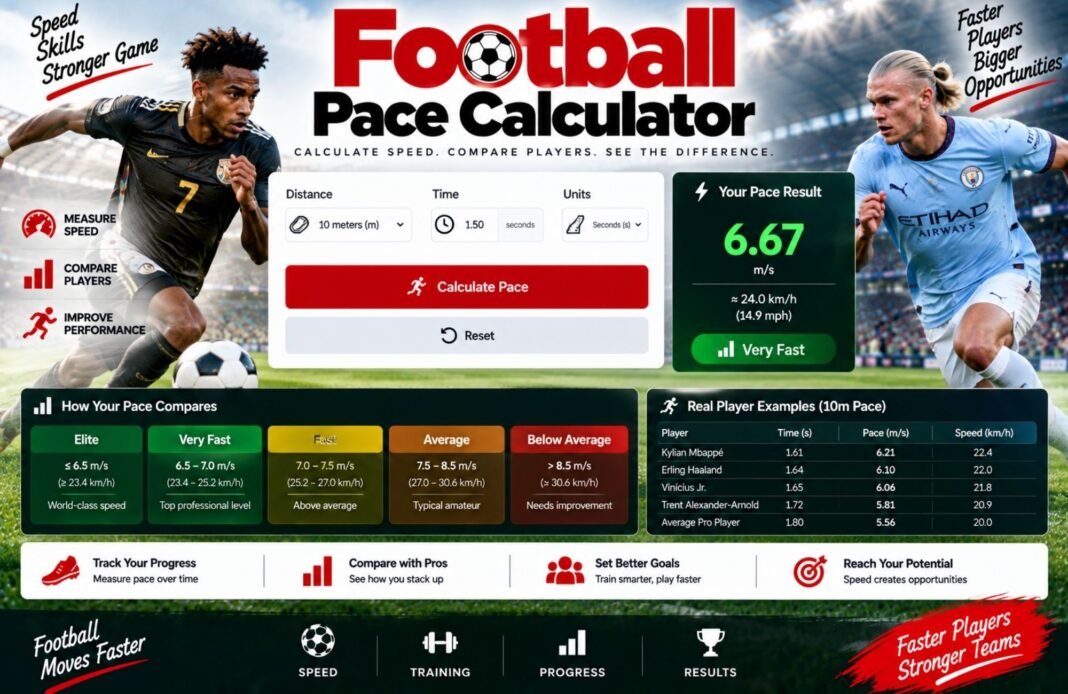
Want to know how fast a football player can move? Our Football Pace Calculator uses distance and time to estimate a player’s running speed and pace. It’s a quick way to track speed, compare performances, and measure improvement on the pitch.
Football Pace Calculator
Use the Football Pace Calculator to convert sprint distance and time into average speed in metres per second, kilometres per hour and miles per hour, with simple 10m, 20m, 30m and 40m pace equivalents.
Football Pace Calculator
Enter the sprint distance and recorded time. The calculator converts the result into several football-friendly speed and pace measures.
Calculate Football Sprint Pace
Use a measured sprint distance and timing result from the same attempt. The result is average speed over that distance, not GPS maximum speed.
Enter the measured test distance.
40-yard tests can be entered directly.
Use the recorded time for the same distance.
Football Pace Calculator Formula
The calculator divides distance by time to find average speed, then converts that speed into other units.
For example, covering 30 metres in 4.20 seconds produces an average speed of about 7.14 m/s, or 25.71 km/h.
Football Pace Calculator: What It Measures
The Football Pace Calculator converts a known sprint distance and time into average running speed. It is useful for simple football testing when you have a stopwatch, timing-gate result or another measured sprint time but want to express the performance in metres per second, kilometres per hour or miles per hour.
The calculator also shows a seconds-per-100m pace and linear 10m, 20m, 30m and 40m equivalents. Those equivalents are mathematical comparisons only. Real sprinting includes acceleration, so an athlete does not normally travel every part of a short sprint at one constant speed.
Average Speed vs Maximum Speed In Football
Average speed and maximum speed are not the same measurement. If a player runs 30 metres from a standing start, the first part of the sprint is spent accelerating. The average speed across the full 30 metres therefore includes slower early steps as well as faster later running.
Maximum speed is the highest instantaneous or short-window speed reached during the effort. FIFA’s player-tracking systems can measure positional data repeatedly and use it to calculate speed, distance and direction, while FIFA player performance metrics can include maximum speed and actions above speed thresholds.
Why The Difference Matters
A player can have a modest average speed over 10 metres but still reach a high top speed later in a longer sprint. Another player may accelerate very quickly but have a lower maximum speed. Both qualities can matter in football depending on the role and match situation.
Football Sprint Speed Zones
FIFA Training Centre material describes a globally recognized high-speed-running range of about 5.5–7.0 m/s and a sprint-zone threshold above 7.0 m/s. The table below converts those values into kilometres per hour and miles per hour for easier reference.
| Speed Zone | Metres / Second | km/h | Approx. mph | How To Read It |
|---|---|---|---|---|
| Below HSR Reference | Below 5.5 m/s | Below 19.8 | Below 12.3 | Below the cited high-speed-running reference threshold. |
| High-Speed Running | 5.5–7.0 m/s | 19.8–25.2 | 12.3–15.7 | Within the cited HSR reference range. |
| Sprint Zone | Above 7.0 m/s | Above 25.2 | Above 15.7 | Above the cited FIFA Training Centre sprint threshold. |
Do not confuse thresholds with player quality. These are speed-zone references, not a universal grading system for whether a footballer is fast or slow. Position, age, test method, start type and match context all matter.
How To Use The Football Pace Calculator
Start by measuring the sprint distance. Football speed tests often use short distances because acceleration is important, while longer runs can provide more opportunity to reach a higher speed.
Step 1: Enter The Distance
Type the test distance and choose metres or yards. The calculator automatically converts yards to metres before calculating speed. For example, a 40-yard sprint is approximately 36.58 metres.
Step 2: Enter The Sprint Time
Use the time from the same attempt. Timing gates are generally more consistent than manual stopwatch timing because human reaction time can affect both the start and finish.
Step 3: Read The Speed Results
The result shows m/s, km/h and mph. Metres per second is especially useful when comparing with sports-science speed thresholds, while km/h is commonly used in football broadcast and tracking discussions.
Step 4: Treat Projected Splits As Mathematical Equivalents
The 10m, 20m, 30m and 40m values assume the same average speed continues across each distance. They are not acceleration-model predictions and should not replace actual split timing.
Football Pace Calculator Examples
These examples show how different sprint distances and times translate into average speed. They are mathematical examples rather than performance standards.
| Distance | Time | Average m/s | Average km/h | Approx. mph |
|---|---|---|---|---|
| 10 m | 1.80 s | 5.56 | 20.00 | 12.43 |
| 20 m | 3.00 s | 6.67 | 24.00 | 14.91 |
| 30 m | 4.20 s | 7.14 | 25.71 | 15.98 |
| 40 yd | 4.80 s | 7.62 | 27.43 | 17.04 |
Why Short Sprint Distances Matter In Football
Many decisive football actions happen over relatively short distances. A player may accelerate to press an opponent, recover defensively, attack space behind a back line or reach a loose ball. These actions do not always require the player to reach absolute maximum speed.
That is why acceleration and top speed should be considered separately. A 10m test emphasizes early acceleration more heavily, while a longer sprint gives the athlete more distance to build speed.
Position Changes The Type Of Speed Needed
FIFA Training Centre analysis has shown that playing positions have different physical demands and that the way high-intensity and sprint distances are accumulated can depend on role and team style. Centre-backs, midfielders, wide players and forwards therefore should not be judged from one sprint number alone.
Metres Per Second, km/h And mph Explained
All three units describe speed, but they are useful in different contexts. Metres per second is convenient for sports science and speed-zone thresholds. Kilometres per hour is commonly used in football tracking reports and broadcasts. Miles per hour may be easier to understand for readers accustomed to imperial units.
Speed Conversions
km/h = m/s × 3.6
mph = m/s × 2.23694
What Can Affect A Football Sprint Test?
Start Method
A standing start, rolling start and flying sprint measure different parts of speed performance.
Timing Method
Manual stopwatch timing can include reaction error, while electronic timing gates can improve consistency.
Surface
Grass quality, artificial turf, indoor surfaces and footwear can change traction and sprint mechanics.
Fatigue
A fresh sprint test can produce a different result from a sprint late in training or a match.
Weather
Wind, temperature and a wet surface can influence running performance.
Distance
Short distances emphasize acceleration, while longer distances allow more time to approach maximum speed.
Football Pace vs Match Speed
A controlled sprint test and a speed recorded during a match are not directly interchangeable. Match running may begin from a moving start, include a curved path, involve the ball or happen under physical pressure from an opponent.
FIFA tracking technology can calculate speed from player positional data collected during matches. That type of system can identify maximum speed and actions above selected thresholds. A simple distance-and-time calculator cannot reproduce all of that tracking detail, but it can provide a transparent average-speed calculation from a measured test.
How To Compare Football Players Fairly
Use the same distance, start method, surface and timing system for both players. Comparing a hand-timed 30m sprint with an electronically timed 40-yard test can create a misleading conclusion even after converting the units.
It is also better to compare several attempts rather than relying on one unusually fast or slow run. If you are tracking development, keep the testing setup as consistent as possible from one session to the next.
Related GlobeHour Football Tools
Use these GlobeHour tools for additional football player context.
Football Pace Calculator Methodology & Sources
The calculator uses standard distance ÷ time arithmetic and unit conversions. It does not estimate biomechanics, reaction time, acceleration curves or GPS peak speed.
FIFA’s football technology documentation explains that tracking data can be used to calculate speed and distance, while FIFA Training Centre material describes high-speed-running and sprint speed thresholds used in football training contexts.
Football Pace Calculator FAQ
Quick answers about football sprint pace and speed calculations.
How do you calculate football pace?
Divide the sprint distance by the recorded time to calculate average speed in metres per second, then convert that value into km/h or mph if needed.
Is average sprint speed the same as maximum speed?
No. Average speed covers the entire timed distance, including acceleration. Maximum speed is the highest speed reached during part of the effort.
Can I enter a 40-yard sprint?
Yes. Select Yards as the distance unit and enter 40 as the distance.
What is the sprint-zone threshold used in the page?
The page references FIFA Training Centre material describing a sprint zone above 7 m/s. Treat it as a speed-zone reference, not a player-quality grade.
Are the 10m, 20m, 30m and 40m times predictions?
No. They are constant-speed mathematical equivalents based on the average speed entered. Real sprint splits are affected by acceleration.
Why can manual timing differ from electronic timing?
Manual stopwatch timing includes human reaction at the start and finish, while timing gates can reduce that source of inconsistency.
Can I compare two players?
Yes, but use the same distance, surface, start method and timing system for the fairest comparison.
Can I download the result?
Yes. The result includes a direct PDF download with “Generated by GlobeHour.com”.
Calculate Football Sprint Pace
Enter a measured sprint distance and time to calculate average speed in multiple units and compare simple pace equivalents.
Open Football Pace Calculator