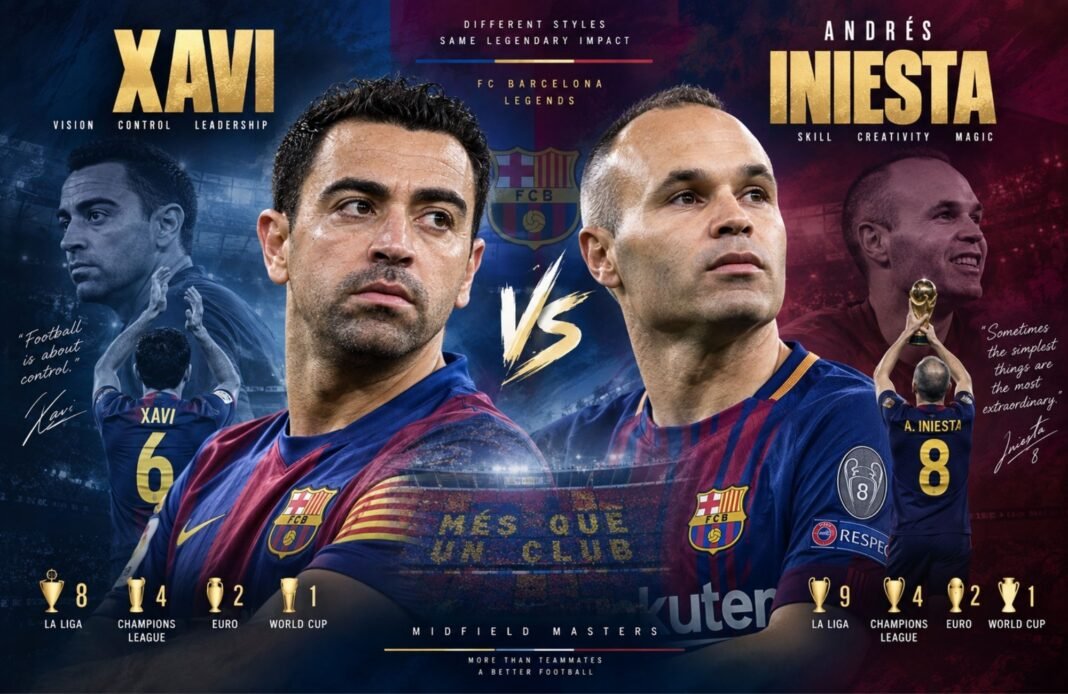
Xavi vs Andrés Iniesta: Two legends, one academy, and decades of football magic. Xavi Hernández and Andrés Iniesta are arguably the greatest midfield duo in football history , and separating them remains one of the sport’s most passionate debates.
For years, they stood a few metres apart in the same midfield, solving the same problems in completely different ways. Xavi made the game feel organised. Iniesta made it feel spontaneous. One could slow a match down until Barcelona were completely in control; the other could suddenly turn that control into a chance with one touch, one turn, or one unexpected burst through midfield.
That is why comparing them is so difficult. Their careers overlap, their biggest trophies overlap, and many of their greatest nights were shared. The numbers help separate them in certain areas, but they do not tell the whole story. To understand the debate properly, you have to look at what each player actually brought to the pitch.
Who Were Xavi and Andrés Iniesta?
Both players came through FC Barcelona’s famous La Masia academy. FC Barcelona’s official Xavi profile traces his journey from the club’s youth system to 17 seasons with the first team, while the club’s official Iniesta profile records his arrival at La Masia at the age of 12. Both wore the red and blue of Barça and the red of Spain for most of their careers. They played side by side, won the same trophies together, and shaped an era of football that may never be repeated.
Xavi became the man Barcelona looked for when a game needed order. He kept moving, kept offering an angle and rarely forced a pass that was not there. His football was built on awareness. He seemed to know where teammates and opponents were before receiving the ball, which is why he could play at such speed without looking hurried.
Iniesta gave opponents a different problem. Closing him down was never enough because he could escape pressure with a turn, a touch or a short burst of acceleration. He was especially dangerous when the game became crowded in central areas. That was often when he looked most comfortable.
Xavi vs Iniesta Playing Styles
The Controller
Xavi built his game around control. His short passes, positioning, and ability to own the tempo allowed him to suffocate a team without the ball ever needing to stay at his feet for long. Few players in history dictated matches the way Xavi did.
His greatest strength was not simply passing accurately. It was choosing the right pass at the right time. Xavi constantly moved after releasing the ball, giving teammates another angle and forcing the opposition to keep adjusting. That constant circulation made Barcelona and Spain incredibly difficult to press.
The Creator
Iniesta was creative, direct, and unpredictable. He could glide past defenders in tight spaces and produce moments that felt impossible. His footwork was poetic, while his composure under pressure was ice-cold.
Where Xavi often controlled the shape of a match, Iniesta was more likely to break that shape. He could beat the first defender, carry the ball through midfield, and suddenly force an entire defensive line to react. That made him especially dangerous in games where space was limited.
Xavi vs Iniesta All-Time Career Stats
Over their full careers, Xavi played more matches and contributed more in terms of raw output.
Xavi has the stronger raw numbers. He played more matches, scored more goals and finished with a much bigger assist total. That makes sense when you consider how often Barcelona and Spain used him as the starting point for attacks. He was involved in almost everything.
Iniesta’s figures are lower, but his game was never easy to measure through goals and assists alone. A lot of his best work happened one action earlier. It might be the dribble that removed a defender, the pass that created the next pass, or the movement that opened space for someone else.
| Stat | Xavi | Iniesta |
|---|---|---|
| Total Matches | 1,064 | 1,016 |
| Goals | 124 | 107 |
| Assists | 251 | 191 |
| Goal Ratio | 0.11 | 0.10 |
| Free Kick Goals | 16 | 2 |
| Penalty Goals | 3 | 18 |
| Trophies | 33 | 37 |
Xavi leads in assists and goals. Iniesta leads in trophies and penalty success.
That contrast sums up the comparison quite well. Xavi’s career numbers reflect long-term control and steady production. Iniesta’s case is built more around decisive moments, major finals, and the kind of individual actions that can change a match in seconds.
Xavi vs Iniesta at a Glance
A quick visual comparison using the career figures in this article.
Career Matches
Goals & Assists
Key Career Numbers
Club Career: Barcelona & Beyond
At club level, Xavi edged Iniesta in almost every attacking stat. He played more games, scored more goals, and provided more assists.
At Barcelona, both represented the same basic idea. Keep the ball, keep moving and make the opposition chase. Their roles inside that system were still different. Xavi was usually the organiser. Iniesta had more licence to carry the ball, drift left and attack the space between midfield and defence.
By the time they left Barcelona, those identities were already fixed in the minds of most fans. Xavi was the organiser of the midfield. Iniesta was the player who could turn a tight situation into an opening with one piece of skill.
| Stat | Xavi | Iniesta |
|---|---|---|
| Matches | 931 | 885 |
| Goals | 112 | 93 |
| Assists | 217 | 161 |
| Trophies | 29 | 32 |
Iniesta has more club trophies though , 32 to Xavi’s 29. In La Liga specifically, Iniesta won nine titles while Xavi won eight.
The difference in silverware is partly about timing. Iniesta remained at Barcelona longer into the club’s later trophy-winning years, which helped him add to his total. Xavi’s club career numbers, meanwhile, benefit from his greater appearance count and larger assist total.
Xavi vs Iniesta in the Champions League
This is where both players truly shine , and where the numbers are remarkably equal.
The UEFA Champions League records show just how deep their experience at the highest European level was. Xavi reached 151 appearances in the competition, while Iniesta made 130.
The Champions League gave both players their toughest weekly test. Barcelona could dominate domestic matches, but in Europe they regularly faced sides with more pace, more physical power and different tactical plans. That was where the calmness of Xavi and Iniesta became especially valuable.
Xavi played more matches and created more goals. Iniesta matched him for goals despite playing fewer games. The numbers are close enough to show why neither man can claim a clear advantage in this competition.
| Stat | Xavi | Iniesta |
|---|---|---|
| Matches | 151 | 130 |
| Goals | 11 | 11 |
| Assists | 31 | 29 |
| Titles Won | 4 | 4 |
Both won the Champions League in 2006, 2009, 2011, and 2015 with Barcelona. Xavi played more games but Iniesta scored his goals in fewer minutes, showing a slightly sharper edge in front of goal at this level.
What matters just as much is the way they handled elite pressure. Against teams that pressed aggressively or defended deep, Barcelona often relied on Xavi to keep the ball moving and Iniesta to find the small openings that eventually broke the opposition.
International Career: Spain
This is where the debate gets emotional. They played together and won everything together , yet their individual marks differ.
With Spain, their partnership became the centre of one of the most successful international eras ever seen. The national team did not depend on direct football or physical dominance. Instead, Spain controlled matches through possession, positioning, and patience , qualities that suited both players perfectly.
Xavi’s international numbers show more assists, while Iniesta finished with slightly more goals. Those figures match their roles: Xavi was the organiser between the lines, while Iniesta was more likely to drive forward and appear in the final action.
| Stat | Xavi | Iniesta |
|---|---|---|
| Matches | 133 | 131 |
| Goals | 12 | 14 |
| Assists | 34 | 30 |
| Trophies | 4 | 5 |
Iniesta has one extra international trophy , winning both the UEFA U-16 and U-19 Championships in 2001 and 2002. Xavi leads in assists. Iniesta leads in goals and overall international trophies.
At senior level, though, their legacies are almost inseparable. Spain’s great run was built around a midfield in which both men understood each other’s movement instinctively. They rarely needed to force the game because their positioning gave Spain control before the decisive moment arrived.
Xavi vs Iniesta at the World Cup
The 2010 World Cup in South Africa defines this debate. Spain beat the Netherlands in the final , and Iniesta scored the winning goal in extra time. That single moment secured him a place in football immortality.
FIFA’s account of the 2010 World Cup final records Iniesta scoring the only goal of the match in the 116th minute, the strike that gave Spain its first World Cup.
The 2010 final was not a flowing game. It was tense, physical and short on clear chances. That made Iniesta’s goal even bigger. When the opportunity finally came in extra time, he did not rush the finish. He waited for the ball to sit up and struck cleanly past Maarten Stekelenburg.
Xavi’s contribution to that World Cup was quieter but constant. Spain’s entire approach depended on keeping control of midfield, and Xavi was central to that. He moved the ball, changed the angle of attacks and helped Spain spend long periods playing the game on their terms.
| Stat | Xavi | Iniesta |
|---|---|---|
| Matches | 15 | 14 |
| Goals | 0 | 2 |
| Assists | 2 | 3 |
| World Cup Titles | 1 | 1 |
Iniesta was more decisive in World Cup matches , two goals, three assists, and the most famous goal in Spain’s history.
That final goal inevitably gives Iniesta a special place in this comparison. Statistics can measure appearances, goals, and assists, but some moments carry a weight that numbers cannot reproduce. For Spain, his strike in Johannesburg is one of those moments.
Xavi vs Iniesta at the EURO Championship
Spain won back-to-back European Championships in 2008 and 2012 , and both players were central figures.
UEFA later looked back at Iniesta’s EURO 2012 campaign, when he was named the tournament’s outstanding player after another title-winning run with Spain.
EURO 2008 was the tournament that changed Spain’s story. Xavi was right at the centre of it as the team finally turned technical quality into a major international trophy. By EURO 2012, Spain had become the side everyone was trying to stop, and Iniesta was one of the players most capable of finding space against packed defences.
The numbers are close. Iniesta played more EURO matches and recorded one more assist. Xavi scored the only goal between them in the competition. Neither total is huge, but both players affected games far beyond the final pass or finish.
| Stat | Xavi | Iniesta |
|---|---|---|
| Matches | 11 | 16 |
| Goals | 1 | 0 |
| Assists | 4 | 5 |
| EURO Titles | 2 | 2 |
Iniesta played more EURO matches and edged Xavi in assists. Xavi scored one goal while Iniesta contributed none directly on the scoresheet.
Again, the score sheet only tells part of the story. Both players influenced where Spain played, how quickly they moved the ball, and how comfortable the team looked in possession against elite international opponents.
Xavi vs Iniesta Trophy Cabinet
Both men stand among football’s most decorated players of all time.
The reason their trophy lists look so similar is obvious. They spent the best years of their careers in the same dominant teams. La Liga titles, Champions Leagues, European Championships and a World Cup appear in both records.
Iniesta finishes with the higher total in the figures used here. The difference comes mainly from domestic cups, one additional league title and one extra FIFA Club World Cup.
| Trophy | Xavi | Iniesta |
|---|---|---|
| La Liga | 8 | 9 |
| Copa del Rey | 3 | 6 |
| Spanish Super Cup | 6 | 5 |
| UEFA Champions League | 4 | 4 |
| UEFA Super Cup | 2 | 2 |
| FIFA Club World Cup | 2 | 3 |
| FIFA World Cup | 1 | 1 |
| UEFA EURO | 2 | 2 |
| TOTAL | 33 | 37 |
Iniesta leads 37 to 33. His Copa del Rey record , six to Xavi’s three , and one extra FIFA Club World Cup title give him the edge in total silverware.
Still, trophy totals should be read carefully. Both played in extraordinary teams, and many of those honours were won together. The count tells us who collected more medals, but it does not by itself settle who was the more influential midfielder.
Penalty & Set-Piece Comparison
Their approaches to dead-ball situations reveal how different they were as players.
Neither player built his reputation around set pieces, but the numbers still reveal a clear split. Iniesta was excellent from the penalty spot when asked to take responsibility. He scored 18 of his 21 attempts.
Xavi’s stronger area was the direct free kick. He scored 16 during his career, far more than Iniesta. It is a small part of the comparison, but it shows again that they brought different tools to the same midfield.
Penalties
18 / 21Iniesta: 18 penalties scored from 21 attempts , an 85% success rate.
Xavi: 3 penalties scored from 5 attempts , a 60% success rate.
Direct Free Kicks
16 vs 2Xavi: 16 direct free-kick goals.
Iniesta: 2 direct free-kick goals.
Xavi vs Iniesta Individual Awards
| Award | Xavi | Iniesta |
|---|---|---|
| UEFA Best Player in Europe | , | 1 |
| Footballer of the Year | 1 | 1 |
| Player of the Year | 1 | 1 |
| Total | 2 | 3 |
Iniesta holds one more individual award , the UEFA Best Player in Europe trophy. Neither won the Ballon d’Or, which remains one of football’s great injustices given their respective careers.
Players like Xavi and Iniesta were always difficult to judge through individual awards. Their influence was often spread across ninety minutes rather than packed into a goal or a headline moment. Sometimes their best action was simply making the correct decision five or six times in the same move.
Neither needed a Ballon d’Or to define his reputation. Both became examples for a generation of midfielders who grew up watching how far technique, awareness and positioning could take a player at the highest level.
So Who Was Better: Xavi or Iniesta?
There is no clean answer , and that is what makes this debate so enduring.
There is no simple way to separate them because the answer depends on what you want from a midfielder. Xavi gave a team control. He was the player who could make a chaotic game feel calm, keep possession moving and decide when the tempo needed to rise or fall.
Iniesta offered something less predictable. He could take the same controlled possession and suddenly break the pattern with a dribble, a run or a pass that opened the defence. He was also responsible for the biggest single moment either player produced for Spain, the winning goal in the 2010 World Cup final.
The career figures favour Xavi in matches, goals and assists. If you want to compare his game with another great controller from a different era, our Xavi vs Luka Modrić comparison looks at their careers side by side.
Iniesta finishes with more trophies in the numbers used here and one more individual honour. Those differences are real, but they still do not settle the argument on their own.
Iniesta finishes with more trophies in the numbers used here and one more individual honour. Those differences are real, but they still do not settle the argument on their own.What made the partnership special was that Barcelona and Spain rarely had to choose between their qualities. Xavi could control the match. Iniesta could change it. For nearly a decade, they did both in the same midfield.
Xavi vs Iniesta: The Final Picture
Statistically, Xavi leads in output. In the figures used here, he has more career matches, goals, assists, and direct free-kick goals.
Iniesta leads in trophies and individual honours. He also owns the defining moment of Spain’s 2010 World Cup triumph.
The honest answer: football needed both of them.
Xavi vs Iniesta FAQs
Who scored more career goals, Xavi or Iniesta?
Using the figures in this comparison, Xavi scored 124 career goals while Iniesta scored 107.
Who had more career assists?
Xavi leads with 251 assists compared with Iniesta’s 191.
Who won more trophies?
Iniesta leads the trophy count in this comparison with 37, while Xavi has 33.
How many Champions League titles did Xavi and Iniesta win?
Both won four Champions League titles with Barcelona: 2006, 2009, 2011, and 2015.
What was Iniesta’s biggest World Cup moment?
Iniesta scored Spain’s winning goal against the Netherlands in extra time in the 2010 World Cup final.