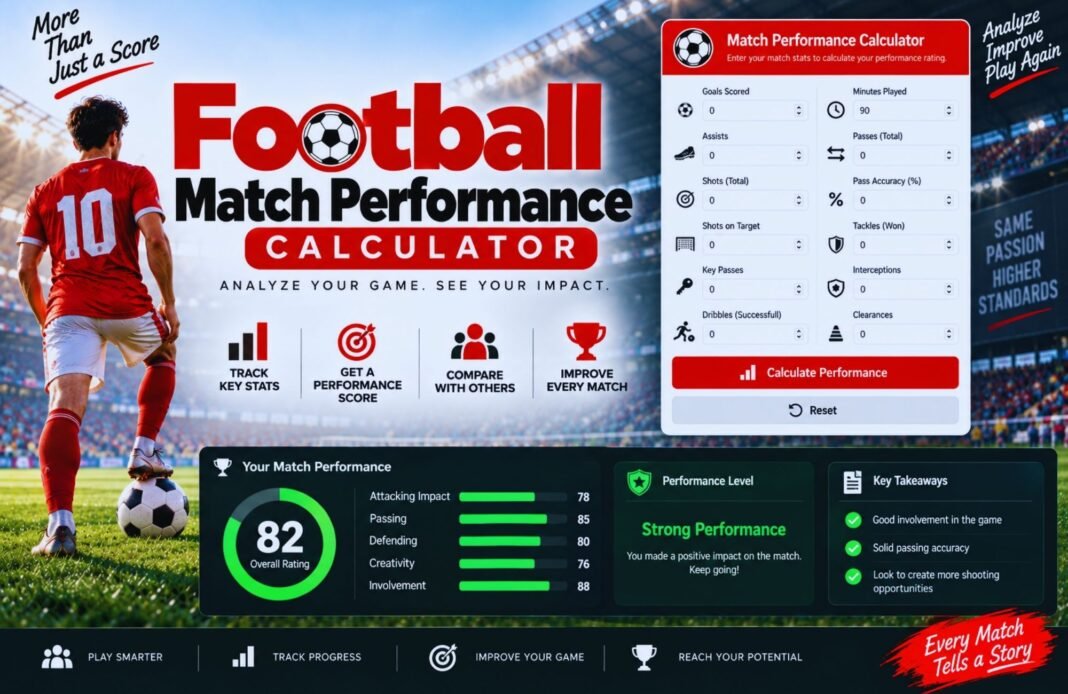
Want to see how well a player performed in a match? Our Football Match Performance Calculator uses key match statistics such as goals, assists, passing, shots, and defensive actions to estimate overall performance. It’s a quick way to review individual displays and compare performances from one match to another.
Football Match Performance Calculator
Use the Football Match Performance Calculator to turn a player’s single-match statistics into a position-adjusted performance score out of 100, with attacking, creative, defensive and goalkeeping context.
Football Match Performance Calculator
Choose the player’s main position and enter statistics from one match. Use 0 for a statistic that did not occur or is not relevant to the player’s role.
Calculate A Player’s Match Performance
The score starts from a neutral baseline and applies role-specific bonuses and deductions from the match data you enter.
Use actual playing time, excluding time not on the pitch.
Outfield players should normally leave this at 0.
Use only major errors with clear match impact.
Football Match Performance Calculator Formula
The tool uses a neutral 50-point baseline and adds or subtracts position-specific contributions from the entered match events.
The final score is limited to 0–100. The same statistic can carry different importance depending on whether the player is an attacker, midfielder, defender or goalkeeper.
Football Match Performance Calculator: What The Score Means
The Football Match Performance Calculator summarizes a single player performance using common match statistics. It is designed to help turn a box score into a more structured review without pretending that football performance can be reduced to one perfect number.
A high score means the entered match included several positive contributions relative to the player’s selected position. A lower score can reflect limited impact, inefficient execution, goals conceded, cards or major errors. The detailed result is more important than the headline score because it shows which areas drove the estimate.
Why Position Matters In A Football Match Performance Calculator
Football positions have different responsibilities. A striker should not be judged by the same balance of statistics as a center-back, and a goalkeeper cannot be evaluated sensibly from goals and assists alone.
Attacker
Goals, assists, shots on target and chance creation receive the strongest positive emphasis. Passing and defensive work still add context but carry less weight.
Midfielder
Creation, pass completion, goals, assists and defensive activity are blended more evenly because midfield roles often connect multiple phases of play.
Defender
Defensive actions, duel success, goals conceded and passing receive more weight. Goals and assists are rewarded but are not the main expectation.
Goalkeeper
Saves, clean-sheet context, goals conceded, passing and major errors dominate the goalkeeper model.
Match Performance Score Bands
The bands below belong to this GlobeHour calculator. They are not an official football rating standard.
| Score | Performance Band | General Interpretation | Use With Caution Because |
|---|---|---|---|
| 85–100 | Outstanding | Exceptional match impact across the player’s main role. | Very high scores should be reserved for genuinely dominant performances. |
| 75–84 | Excellent | Strong positive influence with several high-value contributions. | One headline event should not hide the rest of the match. |
| 65–74 | Strong | Clearly positive performance with good role execution. | Opponent and tactical context still matter. |
| 55–64 | Solid | Generally useful performance without major dominance. | Quiet off-ball work may be underrepresented. |
| 45–54 | Mixed | Positive and negative moments are relatively balanced. | Role-specific instructions may explain the statistical profile. |
| 0–44 | Below Average | Limited positive impact or meaningful negative events. | A low statistical score is not a complete scouting conclusion. |
How To Enter Match Statistics Correctly
Use data from one match only. Do not combine statistics from several games, because this calculator is designed to describe one performance rather than a season average.
Minutes Played
Enter the actual number of minutes the player was on the pitch. FIFA’s analysis definitions use per-90 normalization to compare player contributions across different playing times. This calculator shows a minutes-adjusted action rate in the result for context, but it does not simply multiply every event to 90 minutes because a short substitute appearance can otherwise create unrealistic inflation.
Pass Completion And Duel Win Percentage
Completion rates are percentages of successful actions. Enter the percentage itself—for example, 86 rather than 0.86. Remember that a high completion rate does not automatically mean the player attempted difficult or progressive actions.
Major Errors
Count only serious errors with a clear negative effect on the match. Do not count every misplaced pass, lost duel or unsuccessful shot as a major error.
Football Match Performance Inputs Explained
| Input | What It Measures | Most Relevant For | Important Limitation |
|---|---|---|---|
| Goals | Direct scoring contribution. | Attackers, then midfielders. | Does not describe chance difficulty or overall involvement. |
| Assists | Direct creation leading to goals. | Attackers and midfielders. | Depends on teammate finishing and provider definitions. |
| Shots On Target | Direct shooting threat. | Attackers. | Does not describe shot quality. |
| Key Passes | Chance-creating passes. | Midfielders and attackers. | Definitions can differ between data providers. |
| Pass Completion % | Share of attempted passes completed. | All positions. | Does not show pass difficulty, direction or value. |
| Tackles + Interceptions | Direct defensive ball-winning actions. | Defenders and midfielders. | Good positioning can prevent actions before a tackle is needed. |
| Duel Win % | Success rate in entered physical or contested duels. | Defenders and midfielders. | Not every duel has equal difficulty or importance. |
| Saves | Goalkeeper stops. | Goalkeepers. | Raw saves do not capture shot difficulty. |
Attacker Match Performance
For attackers, the model places the strongest emphasis on goals, assists and shots on target. Key passes can raise the score because forwards increasingly contribute to chance creation, while pass completion and defensive actions are kept as secondary context.
A striker can still receive a strong performance score without scoring if they create chances, test the goalkeeper, link play and contribute effectively. Conversely, one goal does not automatically guarantee an outstanding score if the rest of the statistical profile is weak and the player makes major errors.
Short Substitute Appearances
A substitute who scores in 20 minutes can have genuine high impact. The calculator rewards the goal directly but avoids blindly scaling every event to a full 90 minutes. This keeps short appearances from producing extreme scores simply because of a tiny sample.
Midfielder Match Performance
Midfielders often influence possession, creation and defending in the same match. The midfielder model therefore spreads weight across goals, assists, key passes, pass completion, defensive actions and duel success.
A high pass-completion percentage helps the score modestly, but it is not treated as proof of a great performance by itself. A player completing safe passes under little pressure should not automatically outrank a midfielder attempting difficult progressive actions.
Role Differences Matter
A defensive midfielder and an attacking midfielder can have very different match responsibilities. Use the final result as a general performance summary, then interpret it within the player’s actual tactical role.
Defender Match Performance
For defenders, tackles and interceptions, duel success, passing and goals conceded receive stronger emphasis. A clean sheet adds positive context, but it is not treated as proof that every defender played well because defending is a team outcome.
A defender can play an excellent match while conceding if the goal was unrelated to their actions. The calculator cannot see video, positioning or individual responsibility, so the goals-conceded deduction is deliberately limited.
Defensive Actions Need Context
A high number of tackles can mean strong defending, but it can also mean the team spent a long time under pressure. This is why the tool combines defensive action volume with duel success and other match information rather than using one stat alone.
Goalkeeper Match Performance
Goalkeepers receive the strongest rewards for saves and keeping a clean sheet, while goals conceded and major errors reduce the score. Passing contributes a smaller adjustment because distribution is an important part of modern goalkeeping.
Raw save totals still have a major limitation: six simple saves are not necessarily better than two difficult, match-saving stops. The result should therefore be read alongside shot quality and video context whenever those are available.
Errors Matter More For Goalkeepers
A major goalkeeper error can directly produce a goal, so the goalkeeper formula uses a stronger error deduction than the outfield models. Use the field only for clear, high-impact mistakes.
Worked Football Match Performance Examples
These are simplified examples showing how different roles can produce strong scores through different types of contribution.
| Example | Key Match Stats | Likely Strength | Why |
|---|---|---|---|
| Attacker | 1 goal, 1 assist, 3 shots on target | Attacking impact | Direct goal contributions and threat receive strong forward weighting. |
| Midfielder | 1 assist, 4 key passes, 90% passing, 6 defensive actions | Balanced creation | The midfield model rewards creation, passing and defensive work together. |
| Defender | 8 defensive actions, 70% duels, clean sheet | Defensive control | Defensive volume, duel success and clean-sheet context align with the role. |
| Goalkeeper | 6 saves, clean sheet, 78% passing | Shot stopping | Saves and no goals conceded drive the goalkeeper score. |
What This Match Performance Calculator Cannot See
Football performance includes far more than box-score events. FIFA’s Football Language specifically emphasizes both on-ball actions and off-ball movements and interactions. That is why this calculator should be used as a structured summary rather than a complete performance-analysis system.
Off-Ball Movement
Runs can create space or disrupt a defensive line without producing a direct statistic.
Pressing Quality
Pressure can force mistakes even when the player never wins the ball themselves.
Tactical Instructions
A player may intentionally perform a quieter role to support the team structure.
Opponent Strength
The same output can have very different difficulty against different opponents.
Game State
Responsibilities change when protecting a lead, chasing a goal or playing with ten players.
Action Quality
Two shots, passes, tackles or saves can carry very different value depending on difficulty.
Match Performance Score vs Player Rating
A match performance score and a traditional 1–10 player rating are related but not identical. This tool uses actual event inputs to produce a 0–100 performance index. A journalist, coach or scouting platform may use a different scale and may include video-based judgments the calculator cannot access.
This makes the Football Match Performance Calculator useful for repeatable stat-based reviews, while a broader player rating can incorporate subjective tactical observations and provider-specific data.
Related GlobeHour Football Tools
Use these verified GlobeHour tools for more player context.
Football Match Performance Calculator Methodology & Sources
The weights on this page are GlobeHour editorial assumptions. They are designed to create a transparent educational score rather than reproduce any proprietary club or commercial analytics model.
FIFA’s analysis framework explains totals, averages, per-match measures, per-90 normalization and completion rates, and it also emphasizes that football analysis needs technical interpretation around the data. Those ideas guide the way this page explains match statistics and their limitations.
Football Match Performance Calculator FAQ
Quick answers about the match score and how to use it.
How does the Football Match Performance Calculator work?
Select a position and enter statistics from one match. The calculator starts from a neutral baseline and applies position-specific bonuses and deductions to create a score from 0 to 100.
Is this an official FIFA performance score?
No. It is a GlobeHour educational model and is not an official FIFA, league, club or commercial provider rating.
Why does position change the score?
Football roles have different responsibilities, so goals matter more for attackers while defensive actions matter more for defenders and saves matter most for goalkeepers.
Should I enter statistics from more than one match?
No. This page is designed for a single-match performance. Use one match only.
What should an outfield player enter for saves?
Normally 0. Goalkeeper saves are only used meaningfully in the goalkeeper model.
How are minutes used?
Minutes provide playing-time context and are used for an action-rate summary. The calculator avoids simply scaling every event to 90 minutes because short appearances can otherwise become exaggerated.
What counts as a major error?
Use a serious mistake with a clear negative effect on the match, such as an error leading directly to a major chance or goal. Do not count every minor mistake.
Can I download the result?
Yes. The result includes a direct PDF download with “Generated by GlobeHour.com”.
Calculate A Football Match Performance
Enter one match of player statistics, choose the position and calculate a transparent performance score with role-specific context.
Open Football Match Performance Calculator