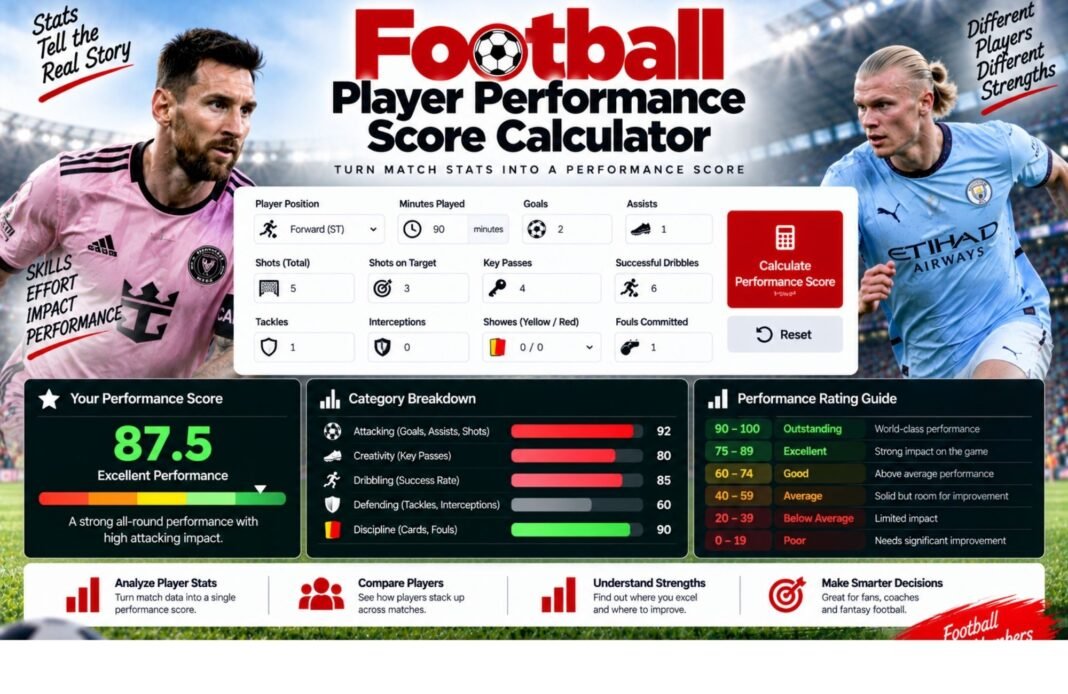
Want a quick way to rate a player’s overall display? Our Player Performance Score Calculator uses key match statistics to estimate a simple performance score. It helps you review individual impact, compare players, and track form from match to match.
Player Performance Score Calculator
Turn one football match into a clear 0–100 performance score. Choose the player’s role, enter the match stats, and see attack, creativity, possession and defensive contribution in one compact result.
Football Player Performance Score
Select the player’s role and enter the match statistics. The calculator normalizes the contribution by minutes played and applies different emphasis for defenders, midfielders and forwards.
Score A Single Match Performance
This is a GlobeHour analytical score, not an official league or governing-body rating. It is designed to make common outfield match statistics easier to compare.
Enter match stats to calculate the score.
Match Stats → Position Weighting → 0–100 Score
The calculator first converts the entered statistics into four category scores, then changes the category weights according to the selected football role.
What Is A Player Performance Score?
A Player Performance Score is a compact way to summarize a footballer’s statistical contribution in one match. GlobeHour’s calculator turns common outfield metrics into a 0–100 score while keeping the underlying categories visible, so the final number does not hide how the player actually contributed.
The tool is not an official competition rating and it is not intended to replace video analysis, scouting or tactical context. It is a structured comparison aid for players, coaches, fans and analysts who want a repeatable way to turn a stat line into a quick performance estimate.
How The Player Performance Score Calculator Works
The calculator groups match actions into four areas: attack, creativity, possession and defense. Goals, shots on target and successful dribbles influence the attacking score. Assists and key passes influence creativity. Pass completion and duels won help describe possession and involvement. Tackles and interceptions drive defensive contribution.
Minutes played are used to normalize counting statistics toward a per-90 basis. This matters because three key passes in 45 minutes represent a different rate from three key passes in a full 90-minute match. The tool caps the per-90 adjustment so very short substitute appearances do not create unrealistic scores from one isolated action.
Normalize Minutes
Counting stats are adjusted toward a controlled per-90 rate.
Build Categories
Attack, creativity, possession and defense are scored separately.
Apply Role Weights
Defenders and attackers are judged with different emphasis.
Return 0–100
The weighted total is capped inside a simple 0–100 scale.
Position-Based Weighting
A football performance should not be judged by the same priorities for every position. A center-back can have an excellent match without taking a shot, while a striker can be decisive with limited defensive involvement. The calculator changes the weighting after you choose the role.
| Role | Attack | Creativity | Possession | Defense |
|---|---|---|---|---|
| Defender | 15% | 15% | 25% | 45% |
| Midfielder | 20% | 30% | 30% | 20% |
| Winger | 35% | 30% | 20% | 15% |
| Striker | 50% | 20% | 15% | 15% |
Important: these weights are a GlobeHour methodology choice, not an official football standard. They are designed to make role-based comparisons more sensible than using one identical formula for every outfield position.
How To Use The Calculator
Start by selecting the player’s main match role rather than the position printed on a squad list. A full-back who played as an advanced wing-back may produce a profile closer to the winger setting, while a wide midfielder with heavy defensive responsibility may be better represented as a midfielder.
Choose Role
Select DEF, MID, WG or ST.
Add Minutes
Enter actual minutes played.
Enter Match Stats
Add attacking, creative and defensive actions.
Read The Breakdown
Use category scores with the overall result.
For the cleanest comparison, use statistics from the same competition and similar match contexts. Different tactical environments can produce very different stat lines even when two players perform equally well in context.
What The Four Category Scores Mean
Attack
Rewards goals, shots on target and successful dribbles. It matters most for strikers and wide attacking players.
Creativity
Reflects assists and key passes or chances created. It receives the highest weight for midfielders and wingers.
Possession
Uses pass completion together with duel success to give context to how securely and actively the player used the ball.
Defense
Rewards tackles won, interceptions and duel contribution, with the greatest weight applied to defenders.
The category breakdown is often more useful than the final number alone. Two players can both score 78 while reaching that number in completely different ways.
How To Interpret A 0–100 Performance Score
| Score | General Reading | Use With Context |
|---|---|---|
| 90–100 | Exceptional statistical impact | Usually multiple high-value contributions |
| 80–89 | Excellent | Strong match across key role areas |
| 70–79 | Very good | Clear positive influence |
| 60–69 | Good | Useful contribution with room to improve |
| 50–59 | Average | Mixed statistical performance |
| Below 50 | Limited statistical impact | May still miss off-ball or tactical value |
A low score does not automatically mean a poor real-world performance. Tactical and off-ball work is not always captured by simple public statistics.
Why Minutes Played Matter
Raw match totals naturally favor players who stay on the pitch longer. To make shorter appearances more comparable, the calculator adjusts counting stats toward a per-90 rate. The adjustment is deliberately limited because a player who scores once in five minutes should not automatically receive the same profile as someone who maintains elite production across a full match.
For very short substitute appearances, treat the score as descriptive rather than decisive. The tool is most informative when a player has enough minutes for the stat line to reflect a meaningful sample of match involvement.
Player Performance Score vs Player Rating
This calculator focuses on a transparent statistical score built from the inputs you provide. A broader player rating may include additional factors, subjective assessment, opponent quality or proprietary event data.
For a separate GlobeHour evaluation tool, use the Football Player Rating Calculator. For role fit rather than match quality, try the Football Position Finder.
Good Uses For A Player Performance Score
- Compare the same player across several matches.
- Review how a change of position affected the statistical profile.
- Separate attacking output from defensive contribution.
- Check whether a strong headline stat is supported by broader involvement.
- Create a simple post-match score for training or analysis notes.
- Use the category breakdown to identify development priorities.
Avoid over-reading tiny samples. One match can be affected by opponent strength, game state, tactical instructions and a player’s specific assignment. Trends across several matches are usually more informative.
Related GlobeHour Football Tools
Player Performance Score Calculator FAQ
What is a good player performance score?
On this GlobeHour scale, 70 or above generally indicates a strong statistical match, while 80 or above represents an excellent result. Context still matters.
Is this an official football rating?
No. It is a GlobeHour analytical calculator and is not an official score from FIFA, UEFA, a league, a club or a data provider.
Does position change the result?
Yes. The overall score uses different category weights for defenders, midfielders, wingers and strikers.
Why does the calculator use minutes played?
Counting statistics are adjusted toward a controlled per-90 basis so shorter and longer appearances can be compared more fairly.
Can I compare two players with this tool?
Yes. Calculate each player using the same role and similar match context, then compare both the overall score and category breakdown.
Does a higher score always mean the player was better?
No. Football performance includes tactical, positional and off-ball work that a simple statistical model cannot fully capture.
Can I use the calculator for a substitute?
Yes, but very short appearances produce less reliable comparisons because a small number of actions can create an unusually high per-90 rate.
Can I download the result?
Yes. The result section includes a simple PDF download.
Score A Football Performance
Choose the player’s role, enter the match statistics and get an instant 0–100 score with a transparent category breakdown.
Open Performance Calculator